Nanosys Super Quantum Dots: BT.2020 and expanded broadcasting from 2026 ££££
Capable of covering the BT.2020 color space, these SQD materials should gradually appear in more affordable models from TCL, some C series to name a few, but also from other manufacturers.
Still on the LCD front, Nanosys also announces a new version of its QD Diffuser Plate (QDP), also found on the X11L diffusers, now BT.2020 compatible and usable in very high-brightness televisions. A version 100% free of heavy metals (cadmium) is planned for 2028.
Nanosys QD OLED 2026: Increased Brightness Thanks to a New QDCC££££
Another major development: a new QDCC (Quantum Dot Color Conversion) formulation will be introduced in 2026. The inks used in the QD OLED 2026 panels, the result of a collaboration with an ink manufacturer, significantly improve the brightness and efficiency of the panels. While Nanosys doesn't name any specific models, it's easy to assume that the Samsung S95H and S99H, the only models equipped with a 2026 generation QD OLED panel, should benefit from this. Nanosys also mentions its 2030 objective: to reach the High Flux level (see photo below), meaning very high brightness for future Micro LED screens intended for augmented reality, capable of reaching several hundred thousand, or even a million nits.
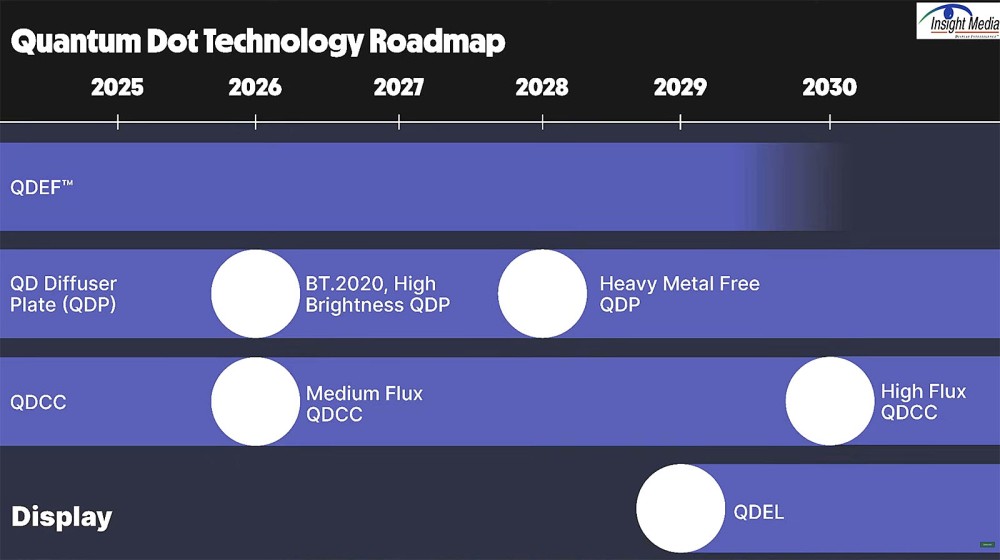
As a reminder, the Low Flux level is particularly suited to classic QLED displays via a QD filter (QDEF) or QD Diffuser Plate, the Medium Flux level concerns, for example, displays equipped with QDCC (e.g., QD OLED TVs), and the High Flux level is particularly intended for displays requiring a very high peak brightness, for example, augmented reality glasses to perfectly blend real-world scenery and superimposed images. Nanosys NanoLED (or QDEL): commercialization planned for 2029. Finally, Nanosys confirms that QDEL technology, also called ELQD or NanoLED, is progressing. Unlike QD OLED or Quantum Dot LCDs, QDEL technology is based on light-emitting quantum dots, capable of directly emitting light and color without backlighting or blue OLEDs. According to Jeff Yurek, Nanosys' marketing manager, interviewed by the YouTube channel Insight Media, 2029 is a realistic window for the commercialization of the first products of this kind, even though the type of panel involved has not yet been finalized. The first models will target Medium Flux brightness levels, far from extreme AR applications, but sufficient for a first generation of NanoLED televisions or monitors.