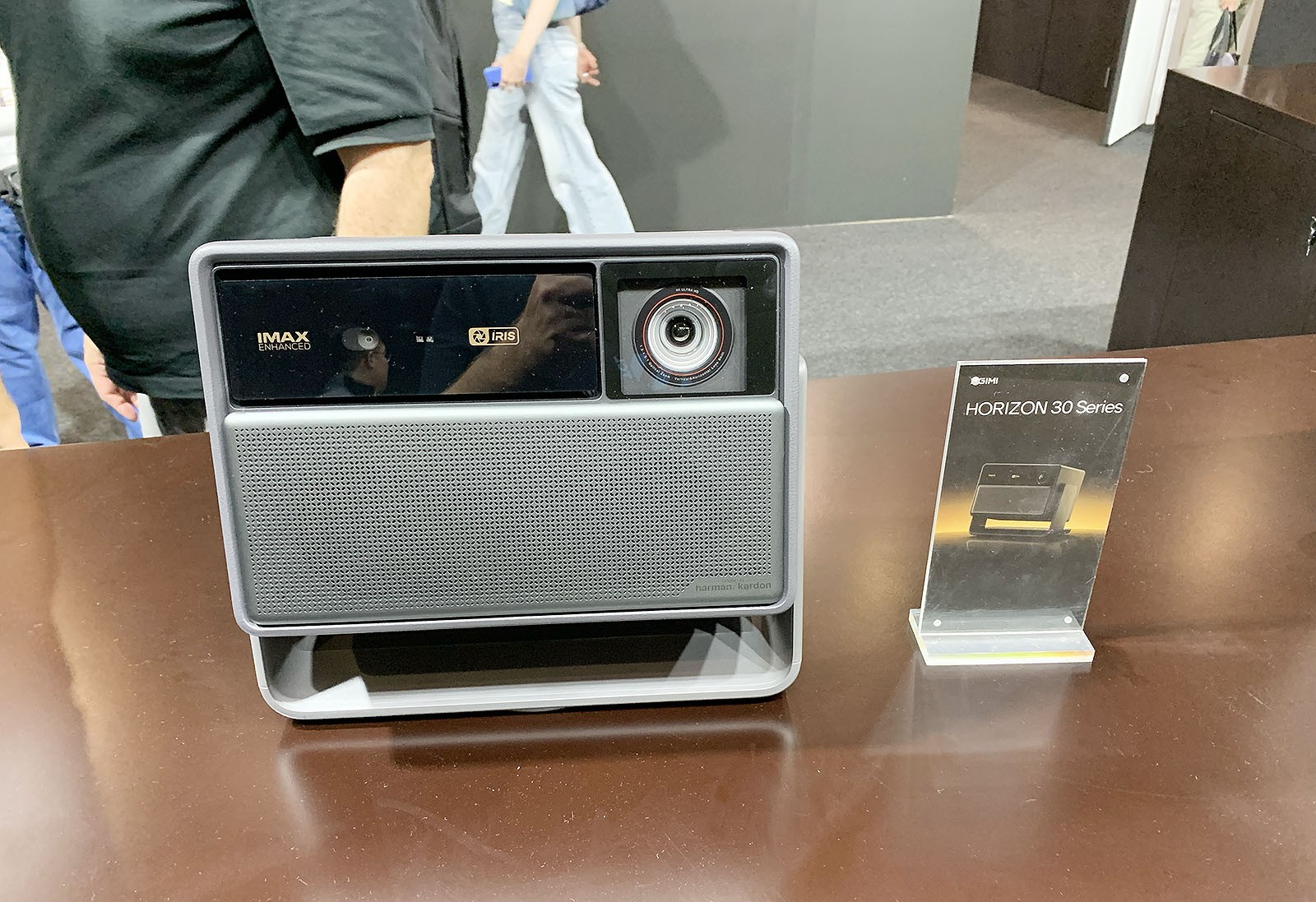
The announcement on the Xgimi booth was rather stealthy, understandably so, since the star of the moment was the ultra-short-throw Aura 3 model, but the “rear-of-room” Xgimi Horizon 30, Xgimi Horizon 30 Pro and Xgimi Horizon 30 Max projectors were on the way. Their launch is scheduled for the end of 2026 and their official unveiling is now in order. On the menu: notable and welcome improvements, including a [abc]2 160p[/abc]/120 Hz display or the Dynamic Dual Iris feature (by pairing a dynamic iris that adjusts in real time to the scene’s brightness with a second physical aperture, Xgimi promises deeper blacks and increased detail in low-light scenes).
Xgimi Horizon 30: familiar design and ISA features
For the rest, Xgimi’s new Horizon 30 references have a look very similar to that of the previous Horizon 20 range, if not identical. The design still features a cubic shape and a tilting, swiveling cradle for aiming the projector as desired. Beyond the form, the Horizon 30 will include all the features of the Horizon 20: the ability to calibrate all Picture modes at will, with separate saving of settings for each of them. Likewise, the calibrated D65 triple-laser mode should normally be retained in order to eliminate the Greenish Tint (on the principle of AWP calibration mode, Alternative White Point, for the White OLED screens we use in our test benches).
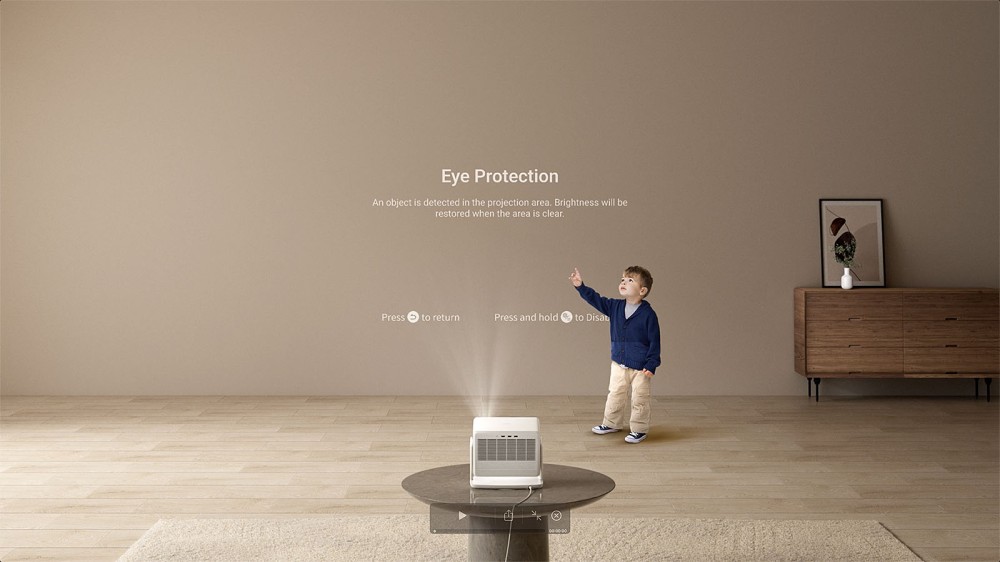
Like its predecessors, the Xgimi Horizon 30 integrates advanced ergonomics presented under the ISA label (Intelligent Screen Adaption). This provides automatic keystone correction and autofocus, in addition to optimal automatic horizontal alignment and automatic screen-size adjustment in the event of a stray obstacle in the image (to perfectly adapt the image to the screen size, for example, or avoid a wall light fixture). Also worth mentioning is the automatic stopping of projection if a person (typically a child) passes in front of the projector lens, in order to protect the eyes. The integrated support allows vertical adjustment reaching 135° and 360-degree horizontal rotation.
Xgimi Horizon 30, QuaLas42 engine and main specifications
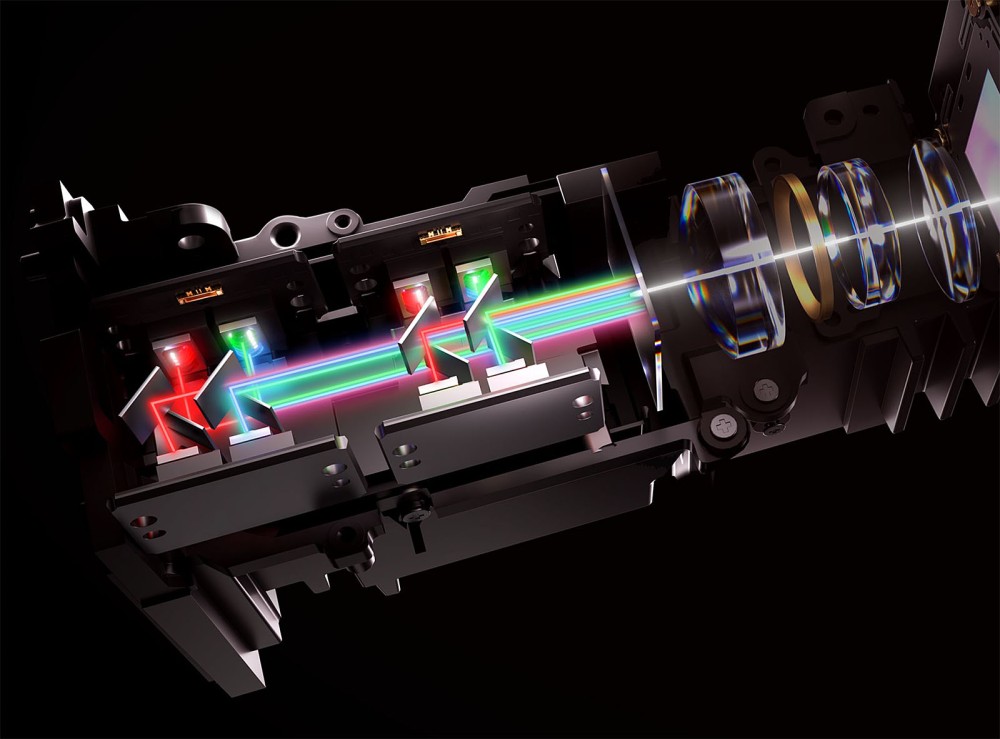
The Xgimi Horizon projectors feature a new in-house optical engine called QuaLas42, a triple-RVB laser composed of twenty laser diodes. The multiplication of these chips, for each of the colors of the triple laser, is intended to control (read: reduce as much as possible) the Speckle phenomena (display of bright sparkles) and Fringing (chromatic aberrations that appear in high-contrast areas of the image or on object edges) inherent to laser technology.
The Xgimi Horizon 30 models are built around a 0.47" SST [abc]DMD[/abc] chip (1,920 x 1,080 pixels) with XPR4 algorithm to display [abc]Ultra HD[/abc] [abc]4K[/abc] resolution. The triple [abc]RVB[/abc] laser light source (25,000-hour lifespan) delivers advertised brightness between 3,600 and 6,800 lumens depending on the model. Native contrast rises to 7,000:1 on the Max version (10,000:1 via the DBLE process for Dynamic Black Level Enhancement and 1,000,000:1 in dynamic contrast) and color coverage of 98% of the BT.2020 spectrum. Note that Xgimi guarantees careful calibration out of the box for its Horizon 30 with a Delta E < 0.8 in Adobe RGB, Rec.709, DCI-P3 and Rec.2020.
We also note compatibility with [abc]HDR Dolby Vision[/abc], HDR10+/HDR10, 3D support (Frame Packing, Side by Side and Top & Bottom), [abc]ISF[/abc], Imax Enhanced and Filmmaker certifications, a Dynamic Tone Mapping process, vertical/horizontal [abc]Lens Shift[/abc] (±120/±45%) and a projection ratio of 1.2-1.5:1 (1.25x optical zoom). The maximum image size is announced at up to 300" (762 cm).
Xgimi Horizon 30: connectivity, connections and audio section
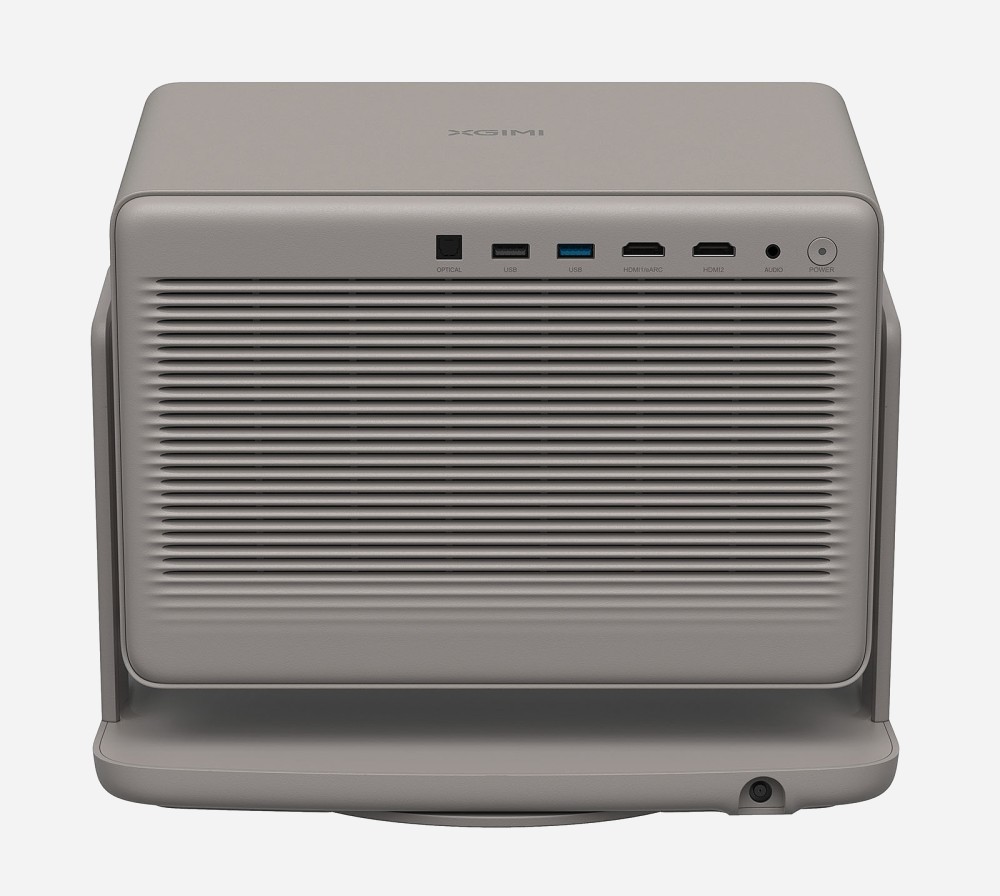
On the connectivity side, among other things, there is one [abc]HDMI[/abc] 2.1 ([abc]eARC[/abc]) input and one HDMI 2.0, one [abc]optical[/abc] output and two [abc]USB[/abc]-A ports (including one 3.0) and a 3.5 mm headphone output. The [abc]ALLM[/abc] and [abc]VRR[/abc] functions are also included. As for connectivity, [abc]Wi-Fi[/abc] 6, [abc]Bluetooth[/abc] 5.2 and [abc]Chromecast (intégré)[/abc] compatibility are on board.
For the Harman Kardon-branded sound section, the Xgimi Horizon 30 delivers a total power of 2 x 12 W and supports Dolby Audio and [abc]DTS:X[/abc] formats.
Xgimi Horizon 30, Google TV
The Xgimi Horizon 20 projector integrates the Google TV Smart TV function for easy access to all (!) [abc]streaming[/abc] platforms (Netflix, Prime Video, YouTube…). Logically enough, the Google Assistant voice assistant is available. Everything is powered by a MediaTek MT9618 processor, supported by 4 GB of RAM and 128 GB of storage.
Xgimi Horizon 30, ideal for video games
Last detail, video game enthusiasts are not forgotten, with a dedicated gaming processor compatible with AMD FreeSync offering an Input Lag of 3 ms in [abc]2 160p[/abc]/60, 2.2 ms in 1,080p/120 Hz and 1 ms in 1,080p/240 hertz. A Black Equalizer mode is offered to brighten dark game scenes and spot hidden enemies or objects. The same goes for Virtual Crosshair mode (on-screen aiming crosshair), very useful with FPS games for example. Finally, there are Sport, FPS, RTS, RPG and of course standard modes. Plus an Assassin's Creed mode to accompany the partnership between Xgimi and Ubisoft on the Assassin's Creed Shadows game.
Availability announced for November 1. Indicative pre-order prices:
• €2,000 for the Horizon 30,
• €2,500 for the Horizon 30 Pro
• €3,000 for the Horizon 30 Max
Prices from November 1:
• €2,499 for the Horizon 30,
• €2,799 for the Horizon 30 Pro
• €3,299 for the Horizon 30 Max
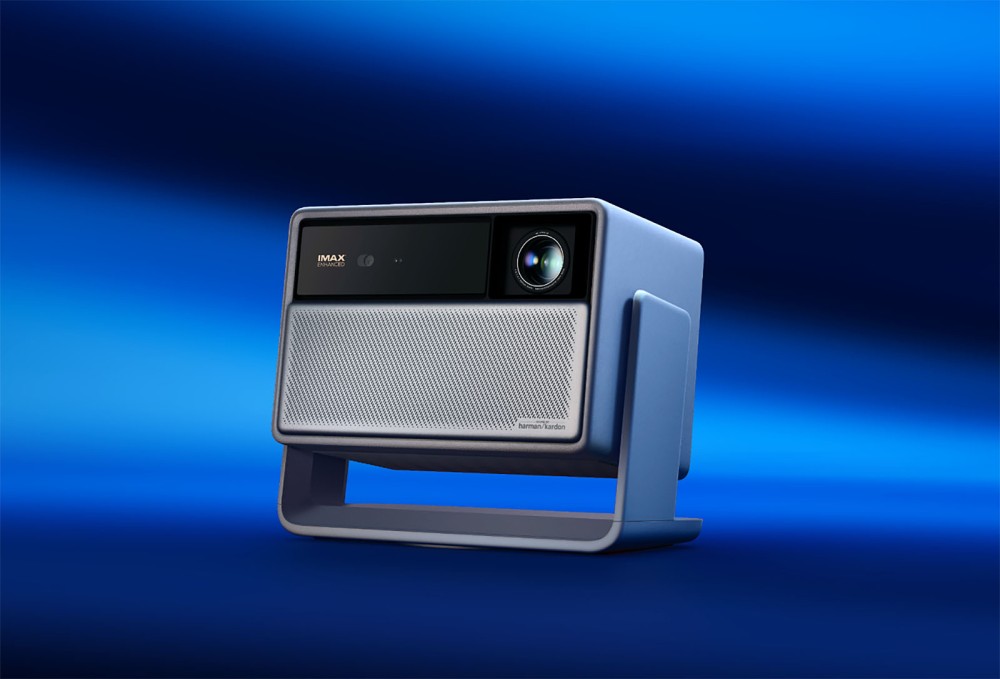
Reminder of the key features of the XGimi Horizon 30 Max:
• Mono-[abc]DLP[/abc] type
• [abc]Ultra HD[/abc] [abc]4K[/abc] resolution
• Native resolution: 1,920 x 1,080 pixels (3,840 x 2,160 with Texas Instrument's XPR4 wobulation technology)
• DMD chip: TI 0.47'' SST
• Contrast: 9,000:1 native
• Light source: triple [abc]RVB[/abc] laser, QuaLas42 engine (20 laser diodes)
• Brightness: 5,300 lumens
• Input Lag: 3 ms in [abc]2 160p[/abc]/60, 2.2 ms in 1,080p/120 Hz, 1 ms in 1,080p/240 hertz
• Google Assistant functions
• MEMC motion compensation functions
• [abc]Chromecast (intégré)[/abc] functions
• Autofocus functions
• Automatic keystone correction functions
• Automatic image alignment to screen size functions
• Google TV functions
• [abc]VRR[/abc] functions
• FreeSync functions
• [abc]HDR10[/abc] compatibility
• [abc]HDR10+[/abc] compatibility
• [abc]3D Ready[/abc] compatibility
• [abc]eARC[/abc] compatibility
• [abc]HDR Dolby Vision[/abc] compatibility
• [abc]Bluetooth[/abc] 5.2 compatibility
• [abc]Wi-Fi[/abc] 6 Dual Band compatibility
• Sound section: [abc]2.0[/abc]
• Power: 2 x 12 W
• Dolby Audio compatibility
• [abc]DTS:X[/abc] compatibility
• 3D compatibility: yes (Frame Packing, Side by Side and Top & Bottom)
• Connections: 1 [abc]HDMI[/abc] 2.1 input ([abc]eARC[/abc]) and 1 HDMI 2.0, 1 [abc]optical[/abc] output and 2 [abc]USB[/abc]-A ports (including one 3.0) and 1 3.5 mm headphone output
• Zoom: 1.2-1.5:1 (1.25x optical zoom)
• Certification: [abc]ISF[/abc], [abc]Imax Enhanced[/abc], Filmmaker
• Lamp life: 25,000 h
• Lens Shift: vertical/horizontal: ±120%/±45%
• Delta E < 0.8 in Adobe RGB, Rec.709, DCI-P3 or Rec.2020