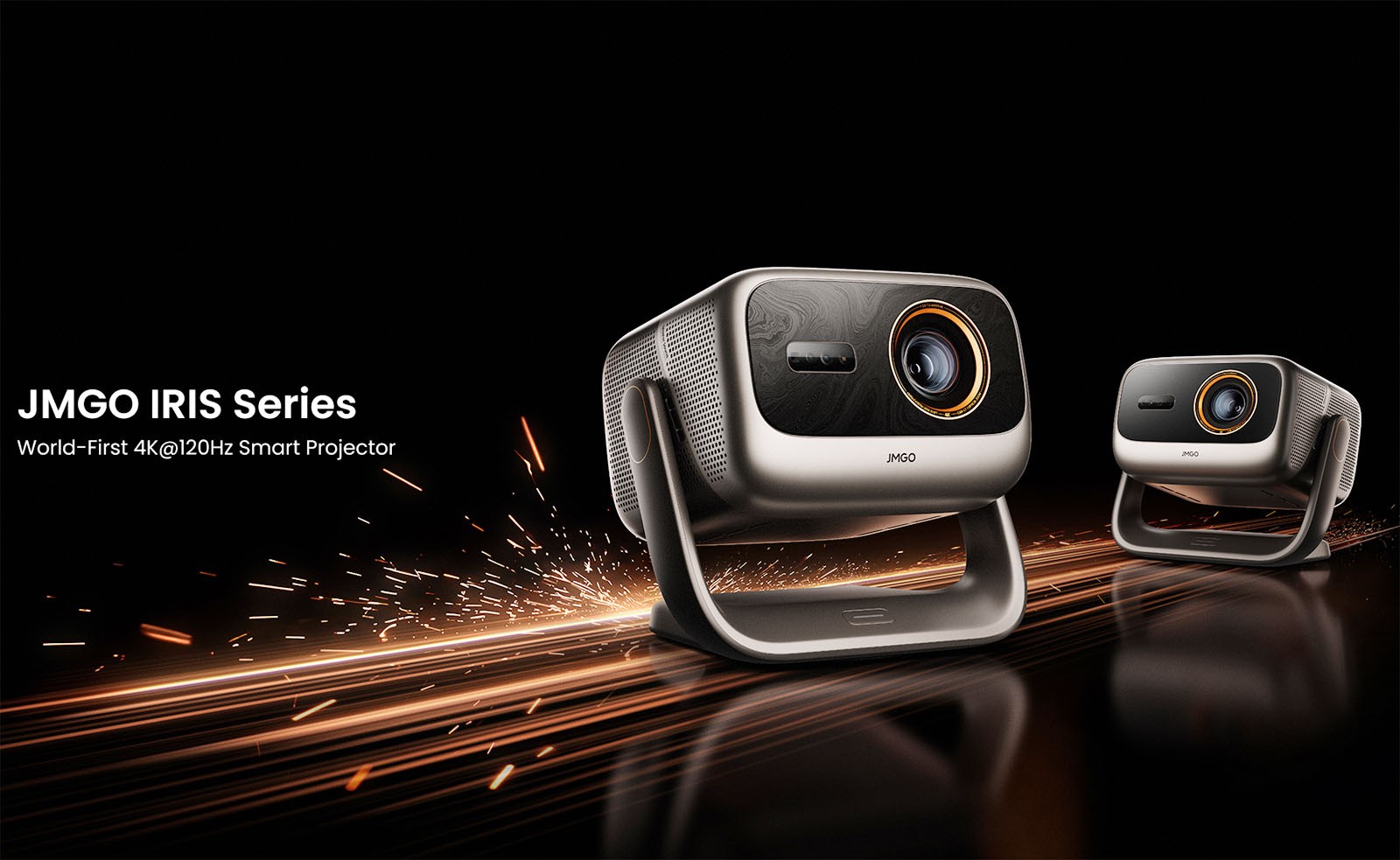
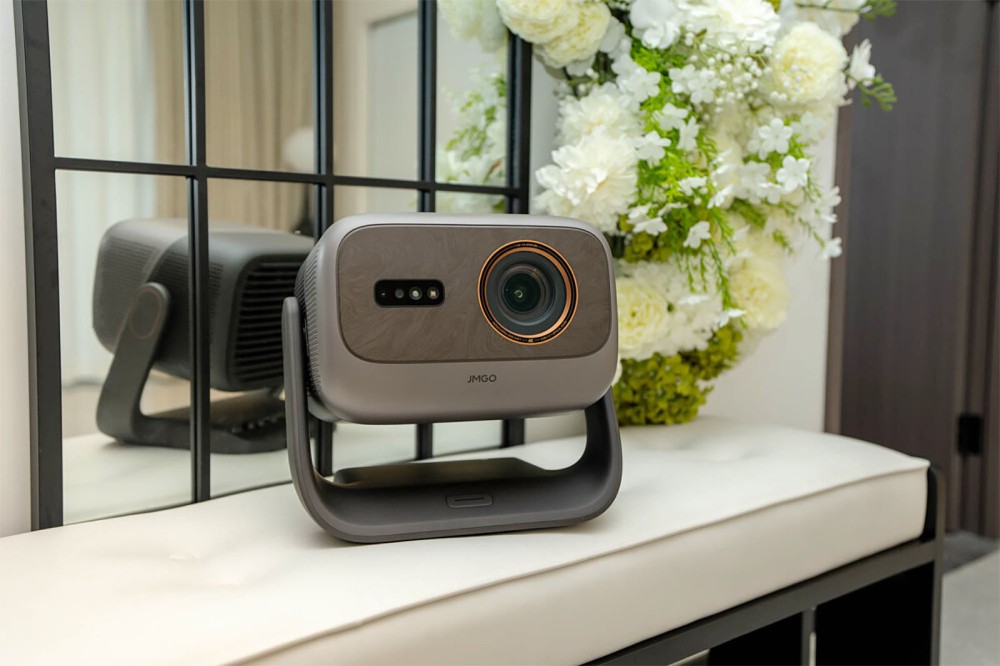
 This extreme fluidity is aimed directly at gamers, who will benefit from lightning-fast latency (Input Lag) reduced to 1 millisecond (in [abc]1 080p[/abc]), support for [abc]VRR[/abc] (Variable Refresh Rate) and [abc]ALLM[/abc]. Unprecedentedly, the projectors support [abc]HDR Dolby Vision[/abc] compatibility directly in UHD 4K at 120 hertz. Film lovers and sports fans, meanwhile, get an optimized MEMC motion compensation system (switchable off for movies) and hardware Anti-RBE technology designed to reduce the [abc]rainbow effect[/abc] without increasing fan noise.
JMGO Iris Ultra Max and Ultra: MALC 6.0 engine, optimized brightness and contrast
Under the hood, the two models use a new 0.47" [abc]DLP[/abc] [abc]DMD[/abc] 472TP chip (better precision and better contrast) plus the new MALC 6.0 triple-laser optical engine, based on the proprietary QuaLas 42 light source. The flagship, the JMGO Iris Ultra Max, claims an impressive brightness of 6,500 lumens and a native contrast ratio of 10,000:1. The Iris Ultra version is a little more restrained with 4,500 lumens and a contrast ratio of 7,000:1.
This extreme fluidity is aimed directly at gamers, who will benefit from lightning-fast latency (Input Lag) reduced to 1 millisecond (in [abc]1 080p[/abc]), support for [abc]VRR[/abc] (Variable Refresh Rate) and [abc]ALLM[/abc]. Unprecedentedly, the projectors support [abc]HDR Dolby Vision[/abc] compatibility directly in UHD 4K at 120 hertz. Film lovers and sports fans, meanwhile, get an optimized MEMC motion compensation system (switchable off for movies) and hardware Anti-RBE technology designed to reduce the [abc]rainbow effect[/abc] without increasing fan noise.
JMGO Iris Ultra Max and Ultra: MALC 6.0 engine, optimized brightness and contrast
Under the hood, the two models use a new 0.47" [abc]DLP[/abc] [abc]DMD[/abc] 472TP chip (better precision and better contrast) plus the new MALC 6.0 triple-laser optical engine, based on the proprietary QuaLas 42 light source. The flagship, the JMGO Iris Ultra Max, claims an impressive brightness of 6,500 lumens and a native contrast ratio of 10,000:1. The Iris Ultra version is a little more restrained with 4,500 lumens and a contrast ratio of 7,000:1.
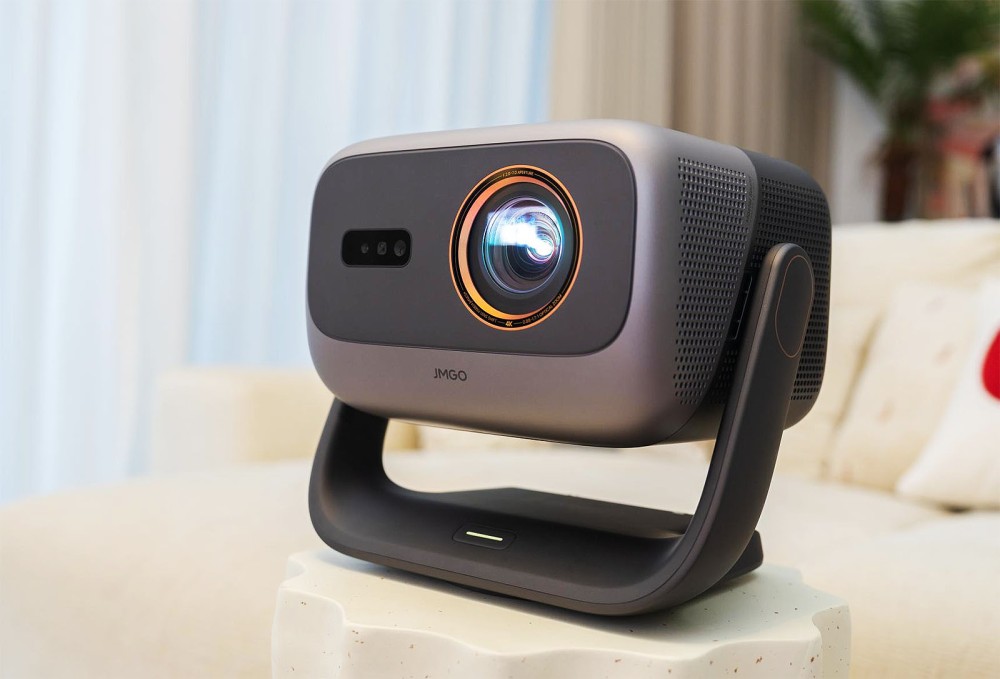 To optimize black depth, the manufacturer integrates a 15-blade Dual-Iris system (6+9 configuration) adjustable across six levels, reducing stray light by 11.34% compared with a conventional iris. This device is supported by JMGO AI DBL software technology, which opens up dark scenes while preserving natural skin tones. Finally, color coverage reaches 110% of the BT.2020 space with a measured Delta E of 0.7.
JMGO Iris Ultra Max and Ultra, 3-in-1 optics and smart motorized gimbal
Installation comfort is the other highlight of this series. The two models share a top-tier optical system including a zoom of 0.88 to 1.7:1 (to project an image from 40" to 300") and an especially generous [abc]Lens Shift[/abc] (lens shift) on four axes: ±130% vertically and ±53% horizontally.
To optimize black depth, the manufacturer integrates a 15-blade Dual-Iris system (6+9 configuration) adjustable across six levels, reducing stray light by 11.34% compared with a conventional iris. This device is supported by JMGO AI DBL software technology, which opens up dark scenes while preserving natural skin tones. Finally, color coverage reaches 110% of the BT.2020 space with a measured Delta E of 0.7.
JMGO Iris Ultra Max and Ultra, 3-in-1 optics and smart motorized gimbal
Installation comfort is the other highlight of this series. The two models share a top-tier optical system including a zoom of 0.88 to 1.7:1 (to project an image from 40" to 300") and an especially generous [abc]Lens Shift[/abc] (lens shift) on four axes: ±130% vertically and ±53% horizontally.
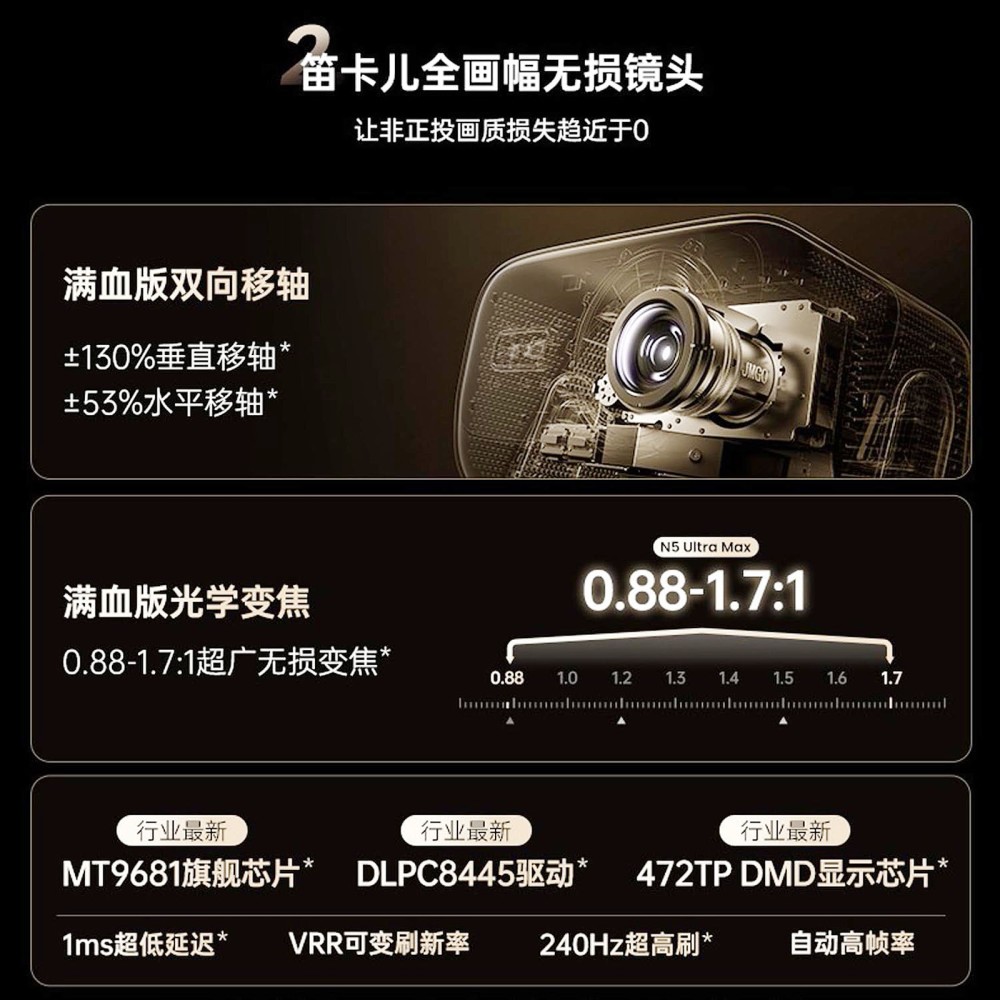 The Iris Ultra Max version stands out by integrating a luxurious motorized, AI-driven gimbal, capable of tilting the device by 150° and rotating it by 360 degrees. Combined with artificial intelligence functions (AI Screen Fitting and AI Spatial Image Memory), the machine memorizes the settings specific to each wall or ceiling in the home and instantly aligns the image when the projection is moved. The standard Iris Ultra benefits from an identical gimbal, but with manual operation.
JMGO Iris Ultra Max and Ultra: Google TV, MediaTek processor and audio section
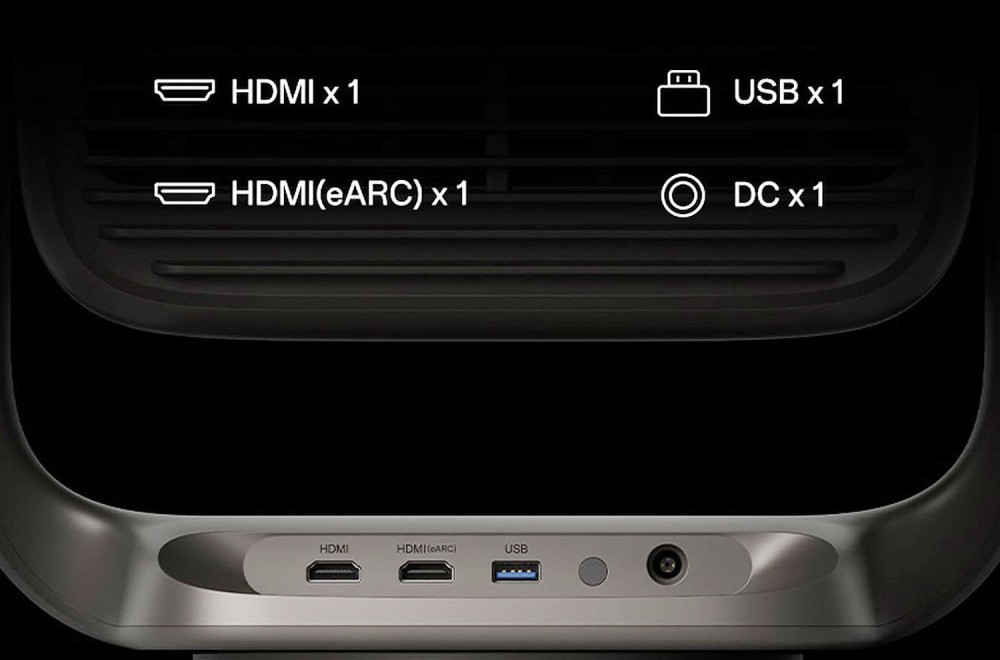
Powered by Google TV with native integration of Netflix and Prime Video, these lifestyle projectors deliver modern connectivity with [abc]Wi-Fi[/abc] 6 and [abc]Bluetooth[/abc] 5.4, while maintaining a claimed noise level of only 26 dB. The heart of the JMGO Iris Ultra Max and Ultra is none other than the MediaTek MT9681 processor with 8 GB of RAM and 128 GB of storage. The audio section is not left behind, with a 2 x 12.5 W stereo system capable of going down to 35 Hz, compatible with Dolby Audio and DTS. Finally, the connectivity includes [abc]HDMI[/abc] 2.1 ports with [abc]ARC[/abc] compatibility.
The Iris Ultra Max version stands out by integrating a luxurious motorized, AI-driven gimbal, capable of tilting the device by 150° and rotating it by 360 degrees. Combined with artificial intelligence functions (AI Screen Fitting and AI Spatial Image Memory), the machine memorizes the settings specific to each wall or ceiling in the home and instantly aligns the image when the projection is moved. The standard Iris Ultra benefits from an identical gimbal, but with manual operation.
JMGO Iris Ultra Max and Ultra: Google TV, MediaTek processor and audio section
Powered by Google TV with native integration of Netflix and Prime Video, these lifestyle projectors deliver modern connectivity with [abc]Wi-Fi[/abc] 6 and [abc]Bluetooth[/abc] 5.4, while maintaining a claimed noise level of only 26 dB. The heart of the JMGO Iris Ultra Max and Ultra is none other than the MediaTek MT9681 processor with 8 GB of RAM and 128 GB of storage. The audio section is not left behind, with a 2 x 12.5 W stereo system capable of going down to 35 Hz, compatible with Dolby Audio and DTS. Finally, the connectivity includes [abc]HDMI[/abc] 2.1 ports with [abc]ARC[/abc] compatibility.
 Availability: pre-orders starting September 4, 2026, deliveries on October 19, 2026. Indicative prices (launch prices): €1,999 for the JMGO Iris Ultra (recommended price €2,499) and €2,999 for the JMGO Iris Ultra Max (recommended price €3,499).
Key features of the JMGO Iris Ultra:
• Type mono-[abc]DLP[/abc]
• [abc]Ultra HD[/abc] resolution
• Native resolution: 1,920 x 1,080 pixels (3,840 x 2,160 with Texas Instrument’s XPR4 wobulation technology)
• [abc]DMD[/abc] chip: TI 0.47" DMD 472 TP, dual DLPC8545 controller
• Contrast: 7,000:1
• Light source: triple [abc]RVB[/abc] laser (MALC 6.0 / QuaLas)
• Brightness: 4,500 lumens
• Input Lag: 1 ms in 1,080p@240 Hz
• Google Assistant functions
• XPR Wobulation functions
• [abc]Chromecast (integré)[/abc] functions
• Automatic keystone correction functions
• Dynamic Tone Mapping functions
• Google TV functions
• RBE Reduction functions (anti [abc]rainbow effect[/abc])
• [abc]VRR[/abc] functions
• [abc]ALLM[/abc] functions
• [abc]HDR10[/abc] compatibility
• [abc]HDR HLG[/abc] compatibility
• [abc]HDR Dolby Vision[/abc] compatibility
• [abc]ALLM[/abc] compatibility
• [abc]eARC[/abc] compatibility
• [abc]AirPlay 2[/abc] compatibility
• [abc]Wi-Fi[/abc] 6 compatibility
• [abc]DTS:X[/abc] compatibility
• Dolby Audio compatibility
• [abc]Bluetooth[/abc] 5.4 compatibility
• Color gamut: 110% Rec.2020
• Audio section: 2.0
• Power: 25 W (2 x 12.5 W)
• 3D compatibility: n/a
• Connectivity: two [abc]HDMI[/abc] 2.1 inputs (4K/120 input compatible), one with [abc]eARC[/abc] function, one [abc]USB[/abc]-A 3.0 port
• Zoom: optical 0.88-1.7:1 (image from 40" to 300")
• Noise level: 26 dB
• Lens Shift: Vertical ±130% Horizontal ±53%
• Vertical keystone correction: yes, automatic
• Other: automatic focus, manual gimbal 360°/150°, MediaTek MT9681 SoC, 8 GB of Ram, 128 GB of Rom, 15-blade Dual-Iris
Key features of the JMGO Iris Ultra Max:
• Type mono-DLP
• Ultra HD resolution
• Native resolution: 1,920 x 1,080 pixels (3,840 x 2,160 with Texas Instrument’s XPR4 wobulation technology)
• DMD chip: TI 0.47" DMD 472 TP, dual DLPC8545 controller
• Contrast: 10,000:1
• Light source: triple RVB laser (MALC 6.0 / QuaLas)
• Brightness: 10,500 lumens
• Input Lag: 1 ms in 1,080p@240 Hz
• Google Assistant functions
• XPR Wobulation functions
• Chromecast (built-in) functions
• Automatic keystone correction functions
• Dynamic Tone Mapping functions
• Google TV functions
• RBE Reduction functions (anti rainbow effect)
• VRR functions
• ALLM functions
• HDR10 compatibility
• HDR HLG compatibility
• HDR Dolby Vision compatibility
• ALLM compatibility
• eARC compatibility
• AirPlay 2 compatibility
• Wi-Fi 6 compatibility
• DTS:X compatibility
• Dolby Audio compatibility
• Bluetooth 5.4 compatibility
• Color gamut: 110% Rec.2020
• Audio section: 2.0
• Power: 25 W (2 x 12.5 W)
• 3D compatibility: n/a
• Connectivity: two [abc]HDMI[/abc] 2.1 inputs (4K/120 input compatible), one with [abc]eARC[/abc] function, one [abc]USB[/abc]-A 3.0 port
• Zoom: optical 0.88-1.7:1 (image from 40" to 300")
• Noise level: 26 dB
• Lens Shift: Vertical ±130% Horizontal ±53%
• Vertical keystone correction: yes, automatic
• Other: automatic focus, motorized gimbal 360°/150° with spatial memory, MediaTek MT9681 SoC, 8 GB of Ram, 128 GB of Rom, 15-blade Dual-Iris
To find our detailed news on the technologies, trends or products mentioned in this summary of the IFA 2026 Berlin show, click on the following link: IFA 2026, discover all the latest directly from Las Vegas