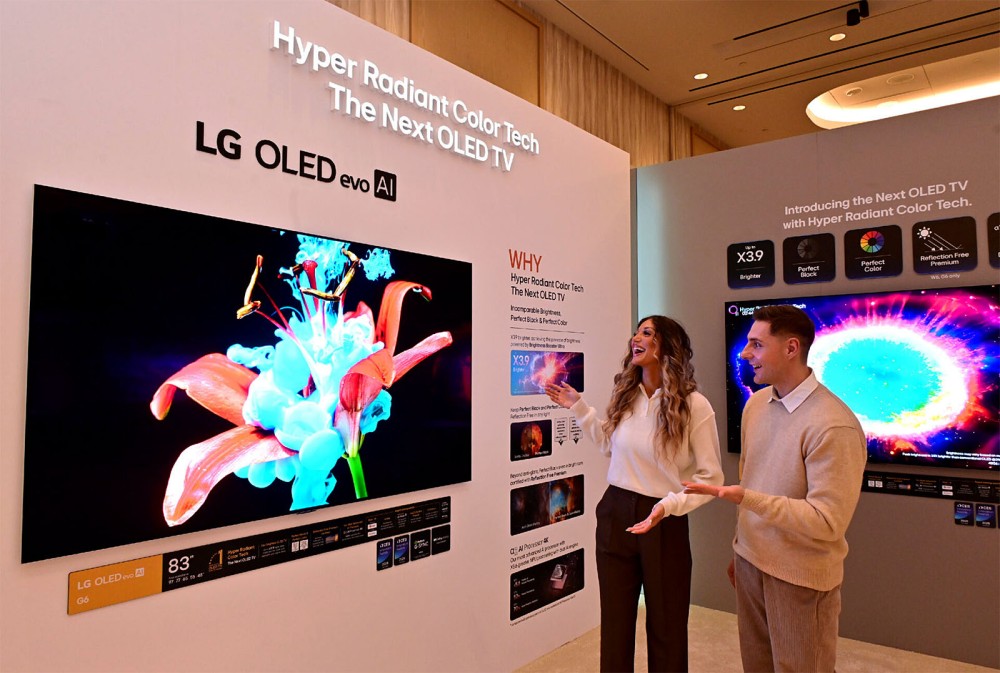
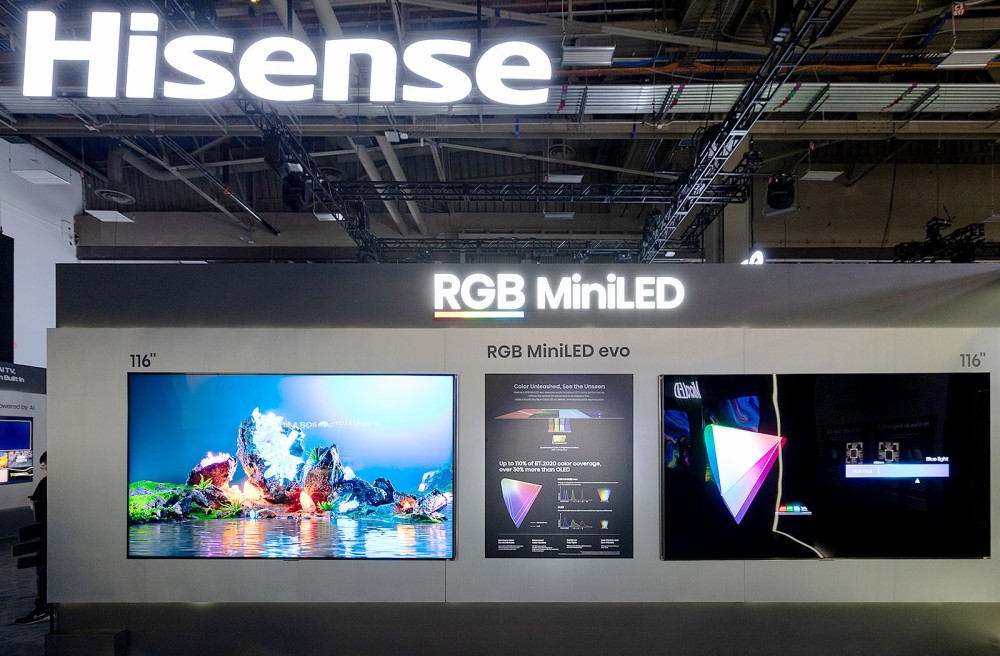
 CES 26, the nit war turns into a color war££££ While improving brightness performance remains relevant, the nit war is no longer primarily at the heart of brand communication (even though TCL announced 10,000 nits for its SQD X11L TV series, see first photo below). This has indeed mutated into a color war, with the Rec.2020 gamut as the reference point, whose coverage, more or less guaranteed at 100% (110% for the Hisense UXS TV), is being highlighted. A new battleground synonymous with technological innovation, opened by the manufacturer Hisense in 2025 with RGB Mini LED technology, and on which the Chinese firm intends to maintain its leadership with the announcement this year of the addition of a fourth color to its premium backlighting systems, that of the Hisense 116UXS RGB Mini LED Evo TVs (see our CES 26 news > RGB Mini LED Evo 4 primaries: Hisense wants to show us all the colors, see photo below) and the Hisense 163MXS Micro LED TVs (see our CES 26 news > Hisense 163MXS: first Micro LED 4 primaries (RGBY) for 100% BT.2020).
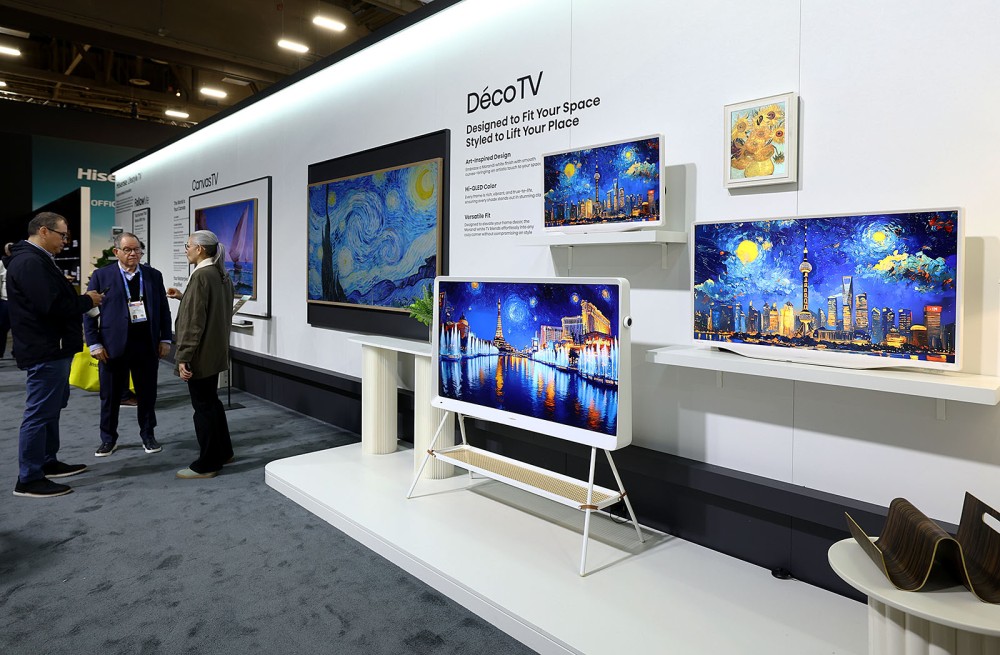
  More generally, CES 2026 will therefore have confirmed the arrival of a third premium display technology, in addition to Mini LED and OLED, within almost all TV brands: Mini LED RGB (Hisense, LG, Philips and TCL) or Micro RGB (LG and Samsung). To be thorough, we must also mention TCL's innovative SQD Mini LED (Super Quantum Dot) technology (see our CES 26 news > TCL X11L SQD Mini LED (Super Quantum Dot Mini LED) TV, 8th generation Mini LED), but the brand indicates that it is essentially a technical evolution of Mini LED. At CES 26, Dolby Vision 2 HDR captivated brands. After its presentation at the IFA trade show in Berlin last September, Dolby Vision 2 HDR technology was one of the stars of CES 2026 in Las Vegas. Not in terms of demonstrations—native Dolby Vision 2 HDR content doesn't yet exist, and the sequences presented are still simulated—but in terms of the brands committed to supporting it. In addition to Hisense, which had declared its support for Dolby Laboratories' latest technology, TCL and Philips will also be contributing, pending the stance of Panasonic and Sony, whose audio-video range presentations are scheduled for the coming weeks (see our CES 26 news article > HDR Dolby Vision 2 on 2026 TVs: Hisense UR9/UR8/UX, TCL X/C series, Philips OLED811/911/951). Samsung, for its part, remains uninterested, and LG is reserving its response for later, promising to announce its involvement in 2027. While LG's decision regarding HDR Dolby Vision 2 is understandable given the anticipated shortage of suitable content, it remains surprising considering the history of the relationship between the Korean group and Dolby Laboratories. LG was, in fact, the first major brand to adopt HDR Dolby Vision on a wide selection of its televisions in 2016, just two years after its introduction. A repeat performance was therefore expected between the two companies. CES 26: Design is increasingly valued by consumers. Another clear fact from CES 2026 in Las Vegas is the proliferation of so-called Lifestyle TVs, whose primary purpose is not only image quality but also easy integration into interior design. This growing demand from a consumer segment is forcing brands and manufacturers to offer increasingly stylish products. A pioneer in this area with its The Frame, The Serif, and The Sero TV series, Samsung is expanding its offering with the Samsung S99H OLED TV series (see our CES 26 news > Samsung S99H OLED TV, updated specifications, see photo below). For its part, LG is expanding its Gallery concept (OLED G series TVs, like Gallery) with, for the first time, Mini LED TVs featuring matte panels (anti-reflective, designed to display over 4,500 artistic content items like paintings; see our CES 26 news > LG Gallery TV and LG Gallery+: new 4K Mini LED Art TV to enhance interior design). Similarly, TCL will be present in this market segment in 2026 with its NXTVision A400 Pro range (see our news article TCL A400 Pro Art TV NXTVision: 144Hz Mini LED at its heart), also based on Mini LED models. Finally, Hisense is also present in this category of televisions through, on the one hand, its Canvas TV series (see photo below), whose design has evolved considerably since the first such display in 2021 with the M1 models, and on the other hand, with the 32" 1080p DecoTV screen (see photo below), which directly competes with the Samsung The Serif.
CES 26, the ultra-short-throw projector war is brewing££££
In the field of imaging, another dynamic is underway: that of ultra-short-throw projectors capable of displaying a very large image size (up to 200 inches, or 508 cm) of high quality. Hisense took advantage of CES 26 to unveil its PX4-Pro (see our CES 26 news > Hisense PX4-Pro: Ultra-short throw TriChroma compatible with 120 Hz and pictured on the left below), immediately challenged by Awol Vision and its Aetherion Pro and Aetherion Max models (see our CES 26 news > The ultra-short throw projector war is brewing: Awol presents its Aetherion Pro and Max and pictured on the right below). CES in Las Vegas, media decline. It's also impossible to ignore the declining media coverage of the CES show in Las Vegas. Few national media outlets covered it (news broadcasts practically ignored the show, or only covered it from anecdotal angles), and there were fewer tweets… Fortunately, with the strong return of automakers present in Las Vegas, automotive news programs did produce some segments, but this is just the tip of the iceberg. In short, CES is still struggling to fully recover after the health crisis. See you in January 2027. To find our detailed coverage of the technologies, trends, and references mentioned in this recap of the 2026 Las Vegas show, click on the following link: CES 2026, discover all the new products live from Las Vegas