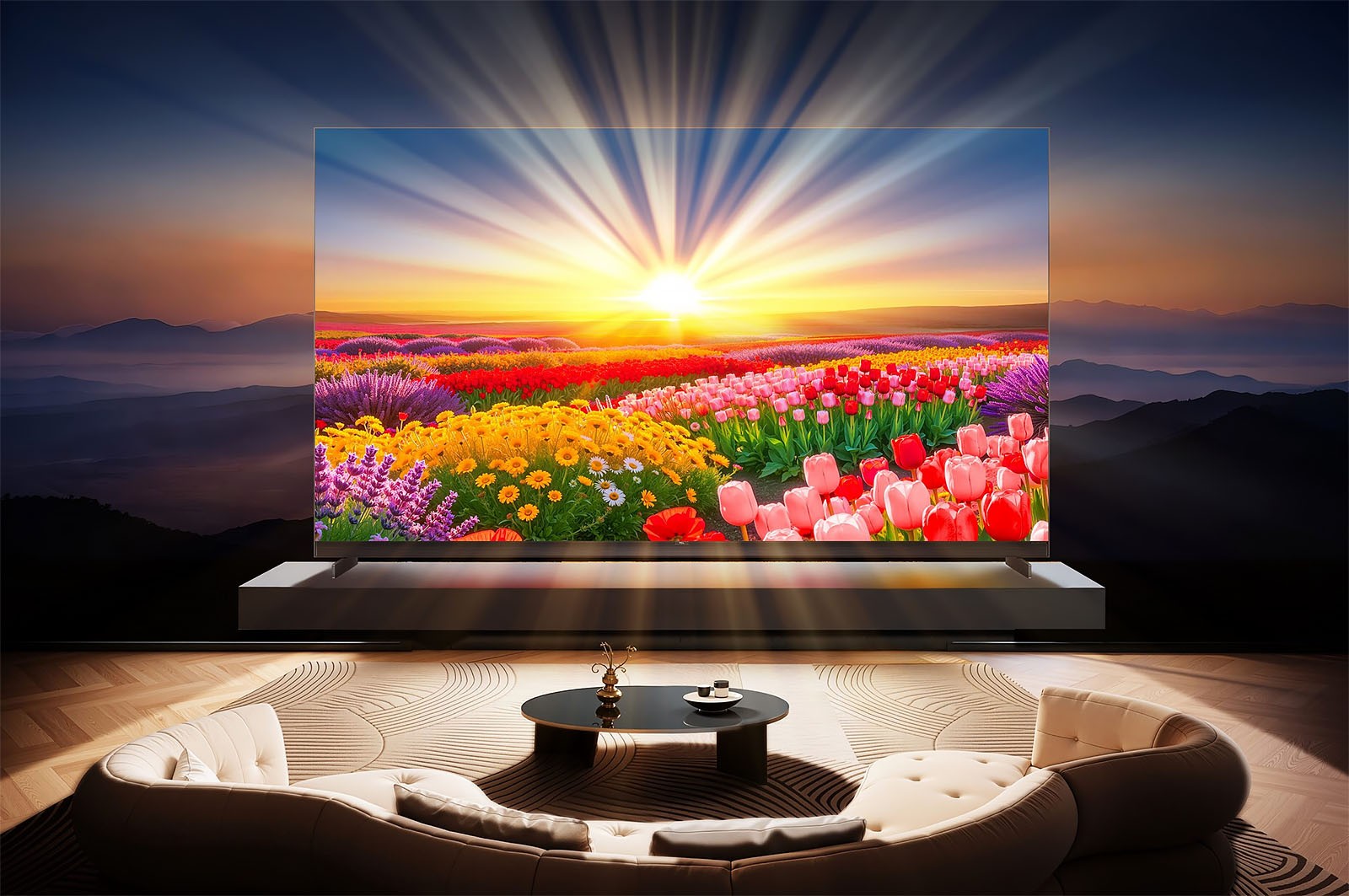
Since the appearance of the very first Mini LED television in late 2019, the TCL-branded X10, this backlighting system has literally flooded the shelves. Yet, behind this label, which very quickly became a major technological selling point for all brands, lie different technical realities. An opportunity for the AVcesar editorial team to offer you a return to basics. Because in terms of image quality, there is clearly Mini LED and Mini LED…
When it marketed its X10 model in 2019, manufacturer TCL caught all the historic giants of the TV industry off guard by shrinking the diodes of its Full LED backlight to the extreme (competitors would only jump on the bandwagon in 2021 by buying panels from CSOT, TCL’s subsidiary) for increased performance. Seven years later, the Mini LED label is displayed everywhere, on entry-level TVs as well as on premium sets at the appropriate price. But beware the spec-sheet mirage: arranging small (mini) diodes behind an [abc]LCD[/abc] panel is not enough to guarantee exceptional [abc]HDR[/abc] performance. Between a low-end Mini LED screen and a premium model, the visual gap in your living room remains abyssal.
Cheap Mini LED (Edge, isolated rows) versus true Full Mini LED (FALD)
Before even looking at raw performance, you need to lift the hood on these TVs to check where the diodes are distributed and how they are driven. Because here is perhaps the ultimate paradox of the TV market: some manufacturers do not hesitate to slap the Mini LED logo on TVs built around a backlighting system that is… LED [abc]Edge[/abc] or reduced to two simple rows of diodes! Instead of covering the entire rear surface of the panel (Direct LED or FALD process for Full [abc]LED[/abc] [abc]Local Dimming[/abc], see photo below), these screens settle for a row of mini-diodes placed around their perimeter (generally at the base of the TV), or even one or two simple horizontal rows located in the center of the chassis, tasked with lighting the image via an optical diffusion plate.
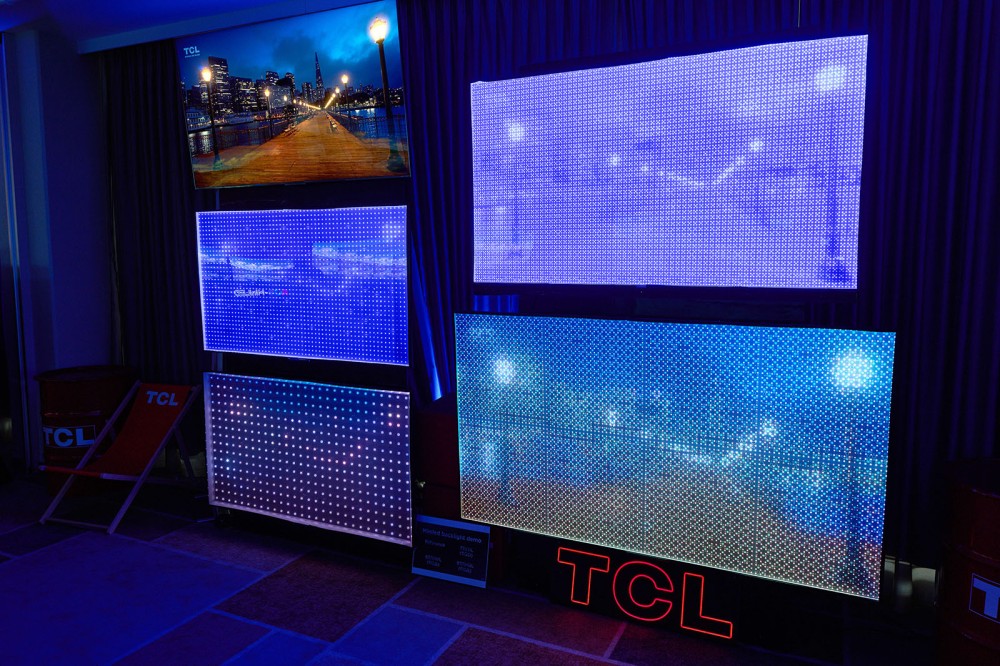
With such an architecture, lacking a true matrix grid, light control amounts to at most a few dozen broad vertical columns incapable, for example, of lighting an object in one corner of the image while completely switching off the rest of the screen. You then lose all the intrinsic benefit of the original Mini LED and fall back on the historic shortcomings of LED Edge or partial Direct LED systems: light leakage, clouding, and difficulty isolating a small bright object on a dark background. At TCL, the inventor of the technology, the rule has been unchanged from day one: Mini LED is designed exclusively in FALD architecture (Full Array Local Dimming), with diodes distributed uniformly behind the entire screen surface.
The huge gap in zones and luminous power
But even within TVs equipped with true Full Mini LED backlighting, a second trap awaits the consumer. No strict standard imposes a minimum number of diodes or independent control zones (Local Dimming) to claim the Mini LED label. As a result, some TVs on the market settle for a few dozen zones and a peak brightness that barely reaches 500 or 600 nits.
Returning to TCL (again, since it originated the process), even the P8L TV series (or P89L), though designed to offer a very affordable price, refuses this compromise and features a true FALD architecture with physically independent zones covering the entire panel (see illustration below), allowing the dark portions of the image around a bright subject to be completely switched off. For the rest of its lineup, the manufacturer, now on its eighth generation of backlighting, multiplies the zones into the thousands (up to more than 2,000 zones on the 98" model in the C79L series, well beyond that on C89L models with up to 4,000 zones, and even up to 20,000 on the largest X11L TV). The point is not to chase numbers, but to offer a level of light segmentation fine enough to light up a star at 3,000 nits at full power while leaving the surrounding cosmos in inky blackness.
Optical distance and micro-lenses: the hunt for blooming
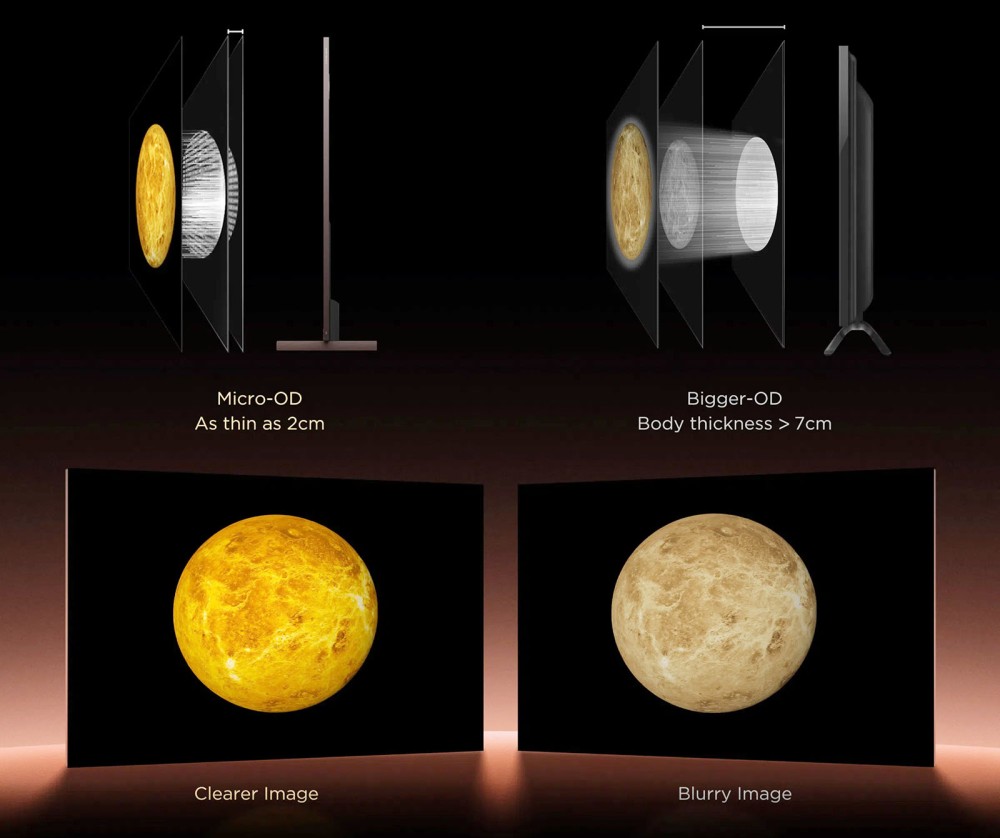
Having lots of light is good. Knowing how to direct it is better. The main enemy of Mini LED remains blooming, that whitish halo effect that bleeds around very bright objects against a dark background (such as movie subtitles embedded in the lower black bar of a cinemascope image). To eliminate this flaw at the root, you have to give credit where credit is due; industrial expertise makes all the difference. Where generic solutions use standard diodes placed far from the LCD panel, TCL has developed, together with its Mini LED, architectures with virtually zero optical distance (OD, for Optical Distance, meaning the physical distance separating the backlight from the LCD panel). Better still, each Mini LED diode is now topped with a refractive micro-lens that concentrates and directs the light beam with millimeter precision, preventing light from spilling into the neighboring zone.
CSOT’s secret weapon: perfected HVA panels and 144 Hz
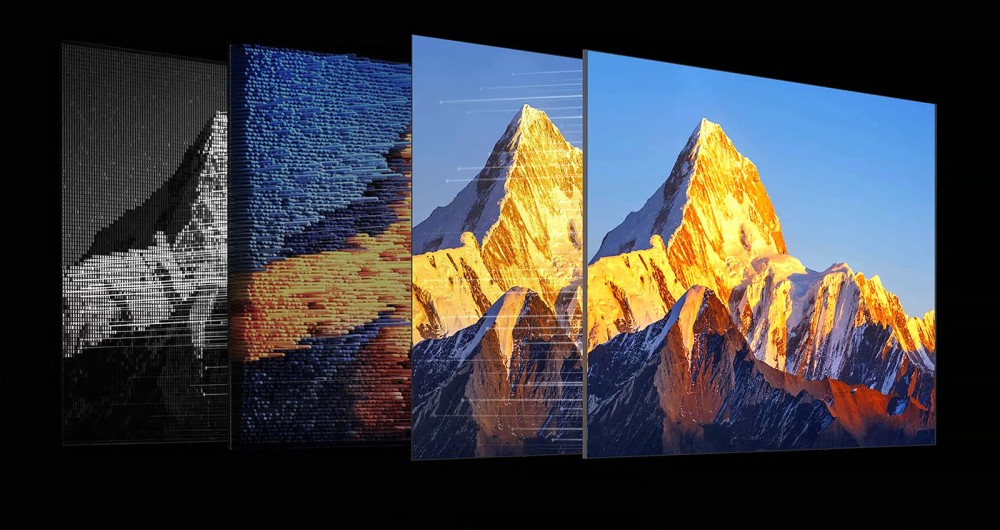
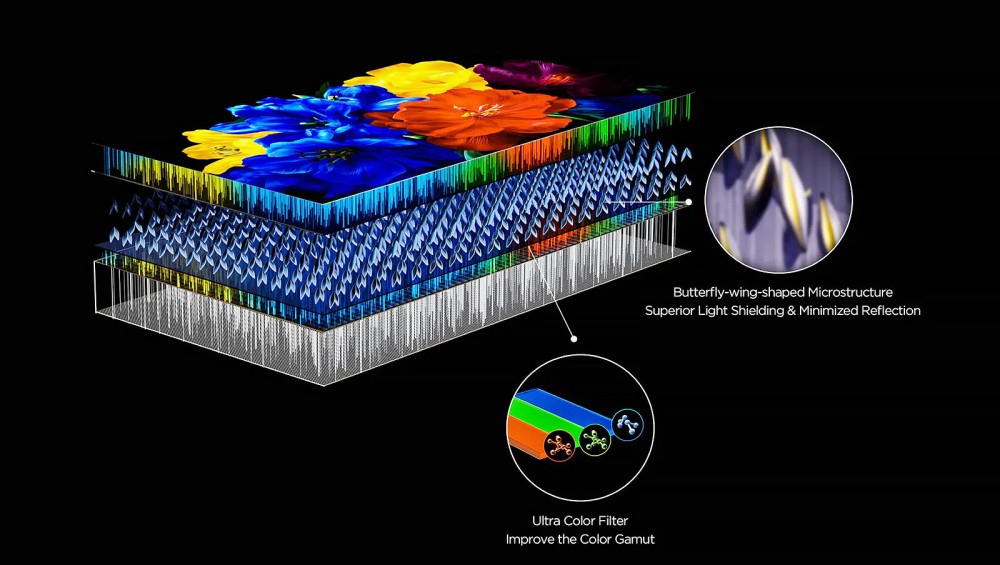
A competitive Mini LED backlight would not be fully exploited without an LCD panel capable of enhancing its performance. This is where TCL gains a decisive advantage thanks to its industrial subsidiary CSOT (China Star Optoelectronics Technology), which designs and manufactures its own panels. Over the years, CSOT has refined its proprietary HVA (High Vertical Alignment) technology, now mature with the HVA Pro and HVA 2.0 Pro variants: by optimizing the molecular alignment of the liquid crystals (butterfly-shaped, see illustration below), the HVA process provides remarkable light-blocking capability that naturally prevents light leakage and drives native contrast to new heights, while limiting stray reflections. Above all, this structure gives the liquid crystals a blistering switching speed. It is this physical responsiveness that makes 144 Hz panels widespread (and up to 288 Hz in Full HD). For viewers and gamers alike, the benefit is twofold: near-flawless image smoothness with no ghosting, and perfect synchronization between pixel refresh and the ultra-fast blinking of the Mini LED backlight.
The key issue: algorithmic control
Finally, even the best engine in the world is of little use without cutting-edge electronics to tame it. Managing thousands of diodes and millions of pixels in real time at 144 frames per second requires colossal computing power. A poorly calibrated Mini LED system will cause unpleasant light pumping, burn out highlights, or crush detail in the shadows. This is where in-house processors (such as TCL’s TSR AiPQ chip, developed in partnership with MediaTek) and 23-bit controlled dimming come into play: analyzing each image on the fly to surgically adjust the intensity of each zone, with no latency.
Industrial mastery that democratizes excellence all the way to SQD‑Mini LED
As you will have understood, the Mini LED logo on a box does not do everything. It is the complete synergy between the diode micro-lens, optical distance, FALD architecture, the responsiveness of the 144 Hz HVA panel, and the processor’s intelligence that sets an exceptional screen apart from a mere upgraded LCD TV. It is precisely because TCL masters this entire production chain in-house through CSOT that the manufacturer today succeeds in democratizing this excellence across aggressively priced series such as P8L (P89L), C6K Pro and C79L, or on C89L models.
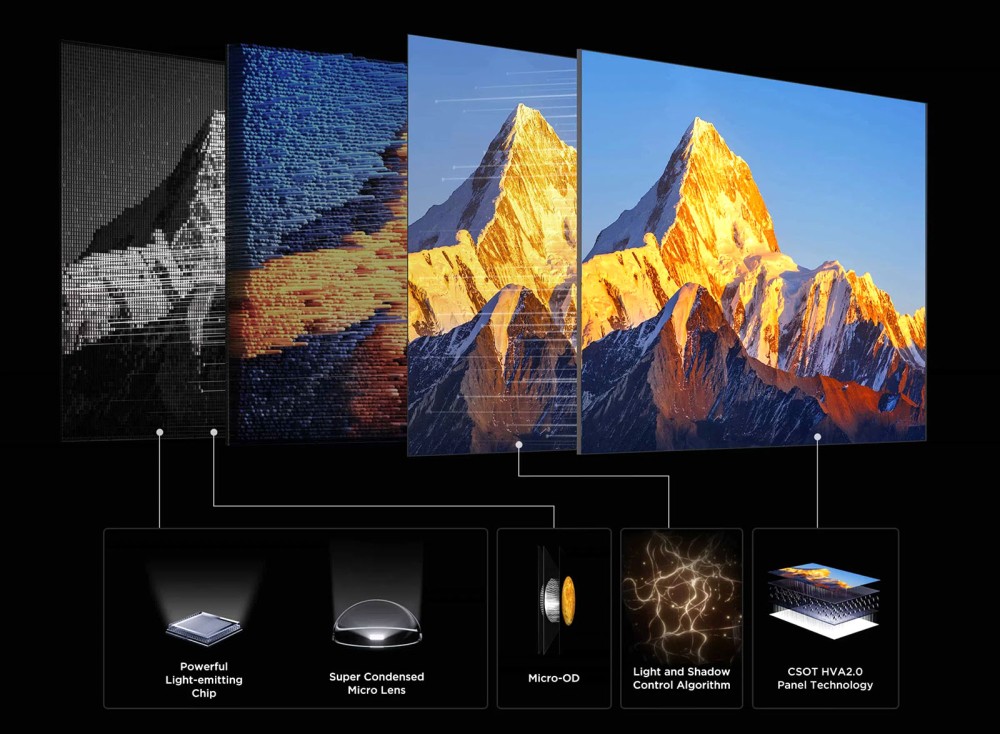
Better still, this mastery now opens the way to the brand’s ultimate technological evolution, introduced on the C7L, C8L and X11L series: SQD‑Mini LED (Super Quantum Dot Mini LED). By combining an extremely dense FALD matrix (up to 20,000 independent zones and 10,000 nits) with a new generation of Super Quantum Dot nanocrystals and a high-precision color filter by CSOT, SQD-Mini LED achieves full coverage of the BT.2020 gamut and absolute chromatic purity.