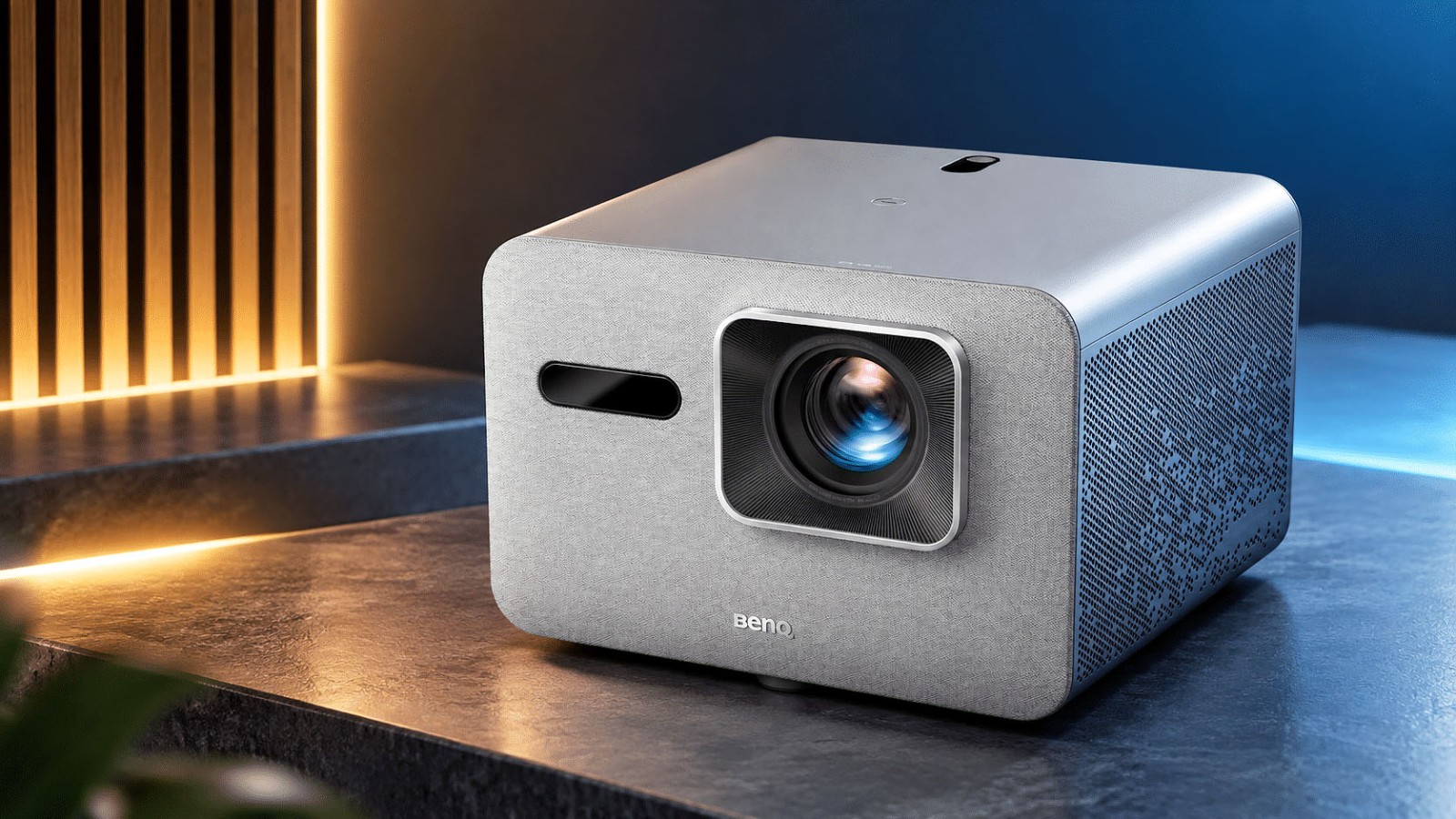
After solidly establishing its TK705i and TK705STi models, the Taiwanese manufacturer takes a new step forward with the BenQ TK715i. Still built around a 0.47'' [abc]DLP[/abc] [abc]DMD[/abc] chip delivering Ultra HD 4K definition through wobulation, this new projector abandons the 4LED light source in favor of the latest Qualas 42 RGB Laser optical engine. This system enables it to reach a generous brightness of 3,200 lumens while offering a dynamic contrast ratio of 1,000,000:1.
BenQ TK715i, Speckle reduction and CinematicColor
The move to [abc]RGB[/abc] laser is often accompanied by a Speckle phenomenon (a grainy scintillation of the image). To counter this flaw inherent to this technology, BenQ has developed an exclusive reduction solution combining static and dynamic diffusers, as well as multi-wavelength and hyper-wavelength lasers. Dynamic range processing is handled by the in-house HDR-PRO process optimized for video projection, with announced support for [abc]HDR Dolby Vision[/abc] and [abc]HDR10+[/abc] formats. The manufacturer also announces impressive color coverage reaching 100% of the DCI-P3 gamut and 95% of BT.2020. The in-house CinematicColor technology also ensures a natural rendering faithful to the directors' intentions, without sacrificing image dynamics.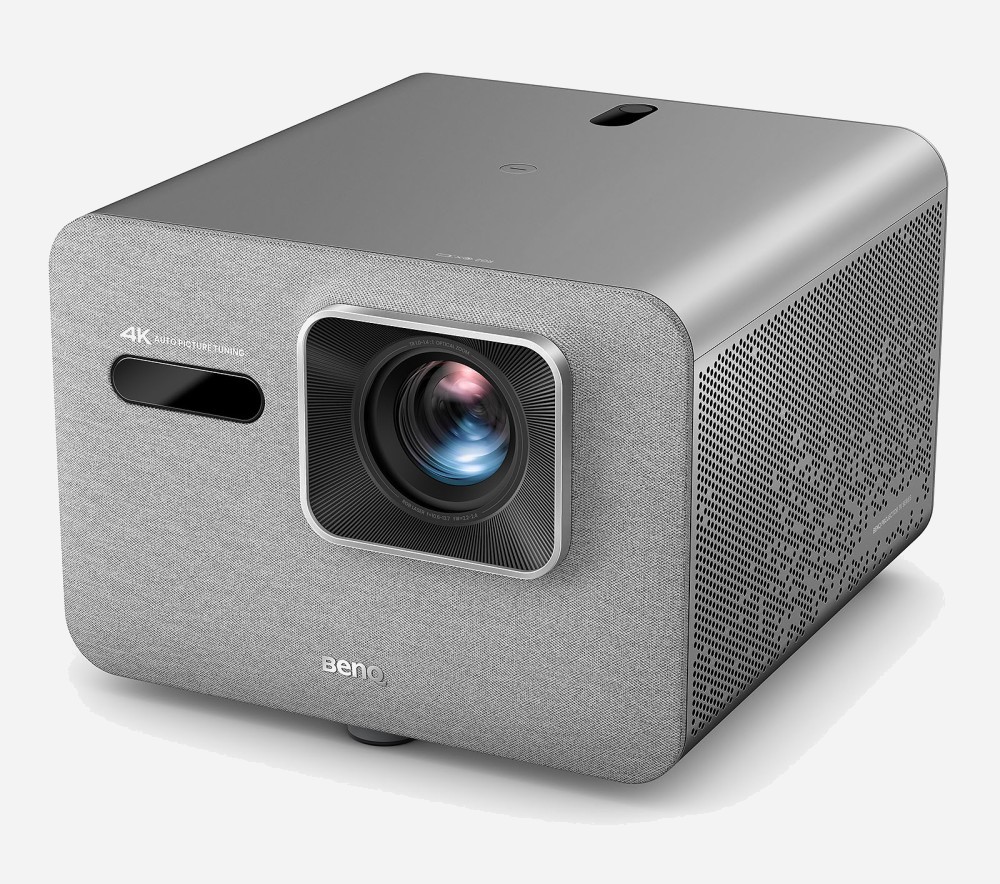 BenQ TK715i, Auto Cinema and GaN power supply
Designed for simplified integration in a living room, the BenQ TK715i relies on the Auto Cinema function. Thanks to sensors and a processor equipped with artificial intelligence (AI scaler and AI Vision), the device automatically adjusts its settings to the wall color, ambient light, and projection distance. Physical installation is made easier by a 1.43x optical zoom and a throw ratio between 0.98 and 1.4:1. Notably, keystone correction and focusing... are optimized thanks to the presence of a new ToF sensor. Focus is now "averaged" across 100% of the screen rather than mainly at the center, for a markedly improved image across the entire surface.
Another practical new feature is that the external power supply now uses GaN technology (delivering up to 320 W), making it possible to reduce the power supply unit's size by 30% compared with the TK705i while improving thermal dissipation.
BenQ TK715i, Auto Cinema and GaN power supply
Designed for simplified integration in a living room, the BenQ TK715i relies on the Auto Cinema function. Thanks to sensors and a processor equipped with artificial intelligence (AI scaler and AI Vision), the device automatically adjusts its settings to the wall color, ambient light, and projection distance. Physical installation is made easier by a 1.43x optical zoom and a throw ratio between 0.98 and 1.4:1. Notably, keystone correction and focusing... are optimized thanks to the presence of a new ToF sensor. Focus is now "averaged" across 100% of the screen rather than mainly at the center, for a markedly improved image across the entire surface.
Another practical new feature is that the external power supply now uses GaN technology (delivering up to 320 W), making it possible to reduce the power supply unit's size by 30% compared with the TK705i while improving thermal dissipation.
 BenQ TK715i, Google TV, MEMC, HDMI 2.1 and 5 ms gaming
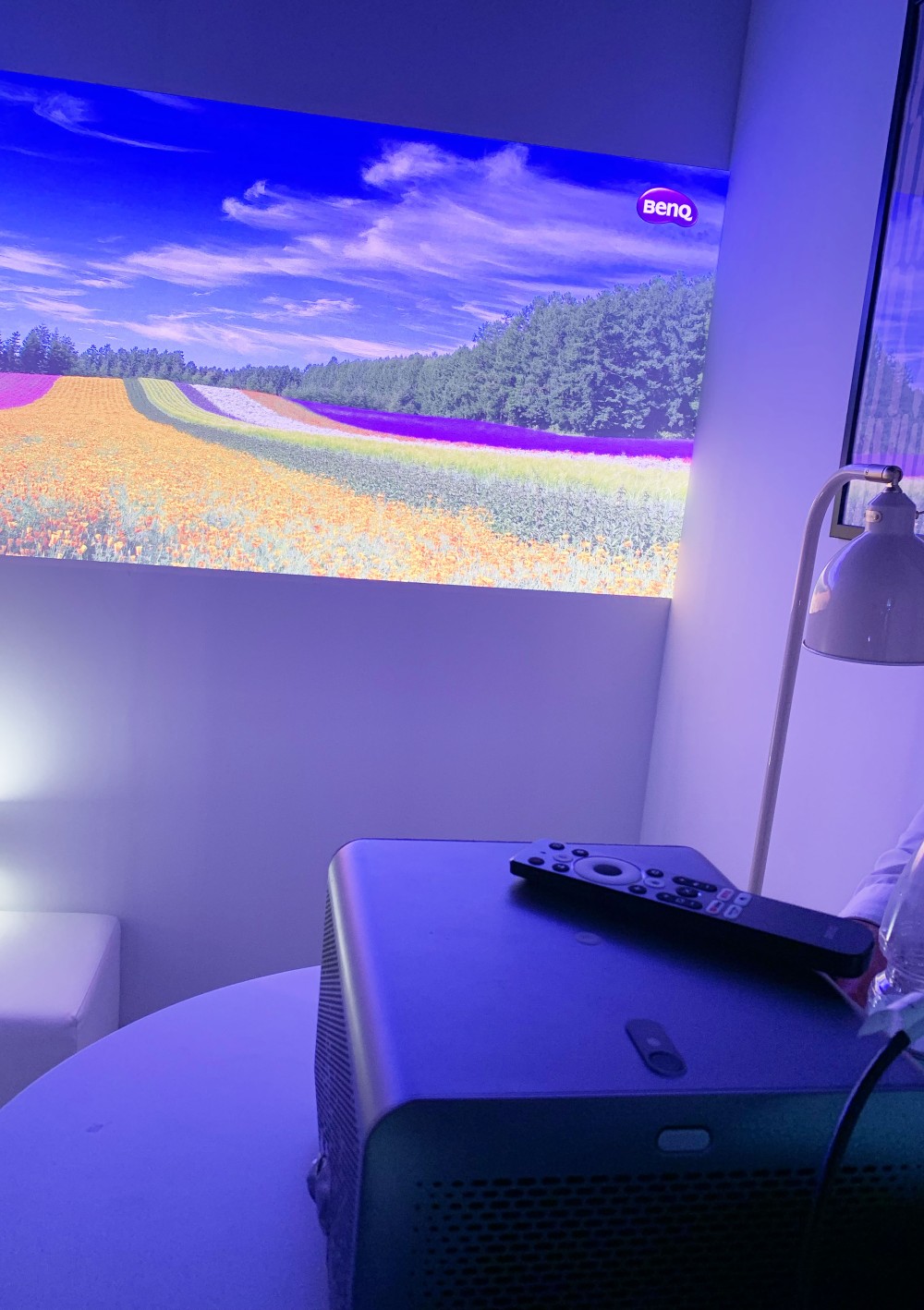
A true standalone entertainment hub, the TK715i incorporates the Google TV operating system, offering direct access to classic [abc]streaming[/abc] apps. On the connected home side, compatibility with the Matter protocol, greatly facilitating integration of the projector into universal home automation ecosystems, is included. The audio section is handled by a stereo system consisting of two speakers delivering 2 x 12 watts. For an always-smooth image during sports broadcasts or action films, the projector includes MEMC motion compensation paired with a dedicated Sport mode. Demanding gamers are not forgotten, as the projector claims a formidable Input Lag of only 5 ms at [abc]2 160p[/abc]/60 hertz. To accommodate next-generation consoles, the connectivity includes two [abc]HDMI[/abc] 2.1 inputs (one compatible with [abc]eARC[/abc]), a [abc]USB[/abc]-A port, a USB-C port allowing 30 W Power Delivery charging, an audio output, and a 12V [abc]Trigger[/abc]. Operating noise remains controlled at 26 dBA in Normal mode and 24 dBA in Eco mode.
BenQ TK715i, Google TV, MEMC, HDMI 2.1 and 5 ms gaming
A true standalone entertainment hub, the TK715i incorporates the Google TV operating system, offering direct access to classic [abc]streaming[/abc] apps. On the connected home side, compatibility with the Matter protocol, greatly facilitating integration of the projector into universal home automation ecosystems, is included. The audio section is handled by a stereo system consisting of two speakers delivering 2 x 12 watts. For an always-smooth image during sports broadcasts or action films, the projector includes MEMC motion compensation paired with a dedicated Sport mode. Demanding gamers are not forgotten, as the projector claims a formidable Input Lag of only 5 ms at [abc]2 160p[/abc]/60 hertz. To accommodate next-generation consoles, the connectivity includes two [abc]HDMI[/abc] 2.1 inputs (one compatible with [abc]eARC[/abc]), a [abc]USB[/abc]-A port, a USB-C port allowing 30 W Power Delivery charging, an audio output, and a 12V [abc]Trigger[/abc]. Operating noise remains controlled at 26 dBA in Normal mode and 24 dBA in Eco mode.
Announced availability for January 2027. Indicative price: 1,799 euros.
Reminder of the key specifications of the BenQ TK715i:
• Single-[abc]DLP[/abc] type
• [abc]Ultra HD[/abc] resolution
• Native resolution: 1,920 x 1,080 pixels (3,840 x 2,160 with Texas Instruments' XPR4 wobulation technology)
• DMD chip: TI 0.47'' SST
• Contrast: 1,500:1 native, 1,000,000:1 dynamic
• Light source: Triple laser RFB (QuaLas42)
• Brightness: 3,200 lumens
• Input Lag: 5 ms at 2,160p/60
• CinematicColor functions
• MEMC motion compensation functions
• HDR-Pro functions
• Google TV functions
• [abc]Chromecast (integrated)[/abc] functions
• Auto Cinema functions
• [abc]HDR10[/abc] compatibility
• [abc]HDR10+[/abc] compatibility
• [abc]3D Ready[/abc] compatibility ([abc]BD 3D[/abc] and DLP Link)
• [abc]HDR HLG[/abc] compatibility
• [abc]ALLM[/abc] compatibility
• [abc]eARC[/abc] compatibility
• [abc]Bluetooth[/abc] 5.2 compatibility
• [abc]Wi-Fi[/abc] 6 compatibility
• Matter compatibility
• Gamut: 100% DCI-P3, 95% BT.2020
• Audio section: [abc]2.0[/abc]
• Power: 2 x 12 W
• 3D compatibility: yes
• Connectivity: 2 [abc]HDMI[/abc] 2.1 inputs, one with [abc]ARC[/abc] and [abc]ALLM[/abc] functions, 1 [abc]USB[/abc]-A port and 1 USB-C port, 1 audio output, 1 12V Trigger
• Zoom: x1.43
• Noise level: 26 dB in Eco mode, 24 dB in Normal mode
• Other: Screen Fit, Object Avoidance, digital zoom, anti-speckle technology (static/dynamic diffusers, multi/hyper-wavelength laser), external GaN adapter (up to 320 W)
• Weight: 3.8 kg
To find our detailed news on the technologies, trends, or references mentioned in this roundup of the 2026 Berlin IFA show, click on the following link: IFA 2026, discover all the new products live from Berlin