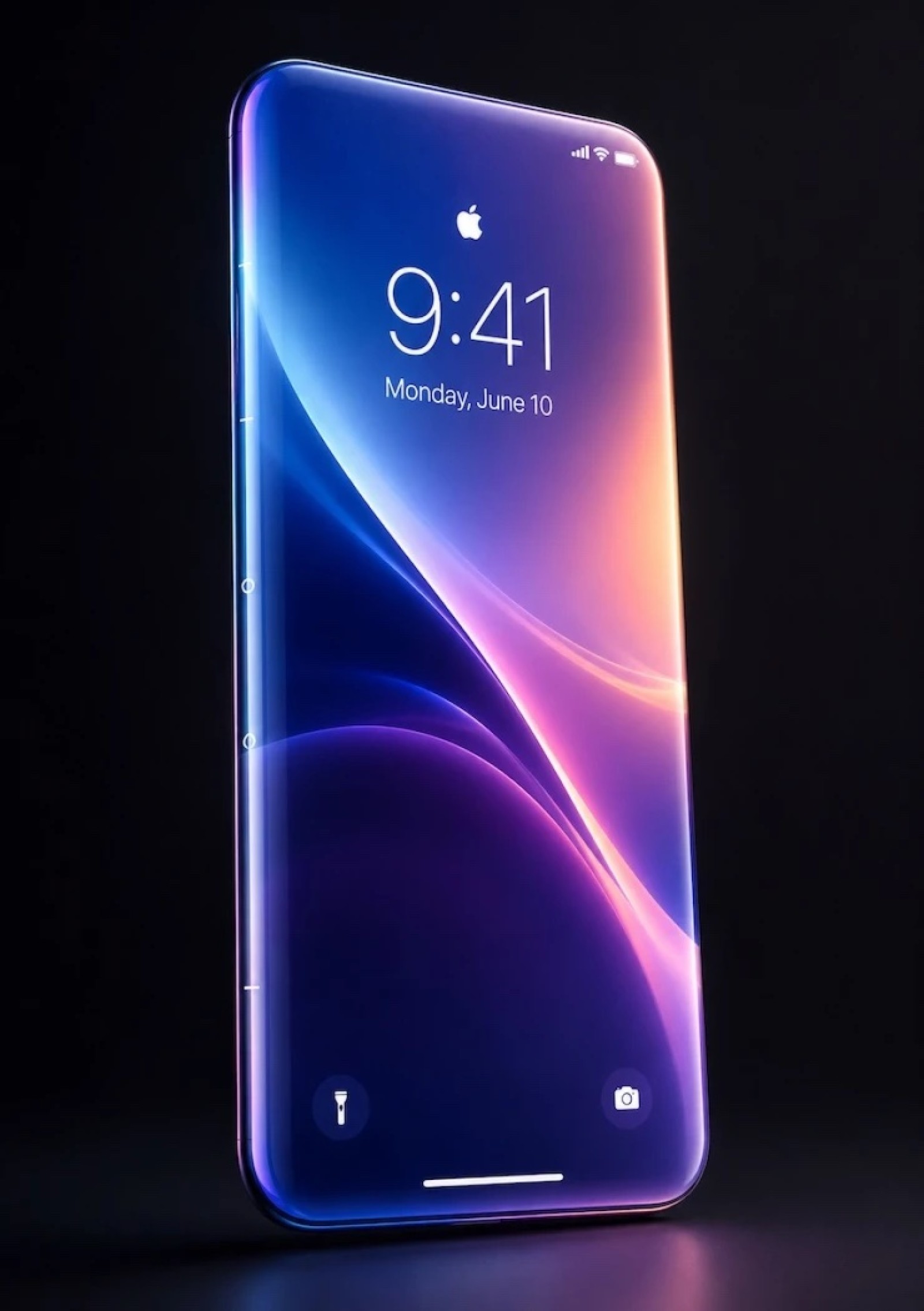
The 10th anniversary of the iPhone in 2017 had been marked by notable innovations on the iPhone X model, notably the edge-to-edge [abc]Oled[/abc] screen and the disappearance of the Home button in favor of a larger screen, not to mention Face ID facial recognition. Apple also wants to make a splash in 2027 for the 20th anniversary of its star product, which should normally be called the iPhone 19 but, knowing Apple, will very certainly adopt the name iPhone XX.
A wraparound design and giant screens
Here is a first summary of what is known about the device, based on rumors that have been circulating for some time, with links where appropriate to our related news:
• “micro-curved” screen, wrapping around all four sides of the smartphone, for a “glass slab” effect, i.e. a screen that appears limitless and spills over uniformly on all four sides of the smartphone
• Screen without the usual polarizing layer, for reduced thickness, thanks to the use of Color Filter on Encapsulation (COE) technology, i.e. a filter that reduces reflections and makes the polarizing layer obsolete. Such a screen would therefore be thinner, would let through more light thanks to increased transparency and would help increase battery life
• iPhone XX available in two versions, for two different sizes, and the largest dimensions ever seen on an iPhone
• The larger of the two models would be equipped with a 6.96" screen (rounded to 7", equivalent to 17.78 cm), the largest diagonal ever seen on an iPhone, with an expected resolution of 2,912 × 1,340 pixels. The smaller iPhone XX would have a 6.41" screen (16.28 cm) with a resolution of 2,686 × 1,236 pixels
• Elimination of buttons, replaced by invisible “touch” surfaces, similar to the Home button on the iPhone 7 and 8. In addition, an ultra-low-power microprocessor would keep the buttons active even when the device is turned off, knowing that they will no longer be mechanical but electrical
• A pure silicone battery could be added, replacing graphite for greater energy density, more battery life, and a longer lifespan than current versions