 Oled as the ultimate flagbearer
The fact that Panasonic is keen to retain its position as a benchmark TV manufacturer is an extremely positive sign for movie lovers. The brand says that [abc]Oled[/abc] is the royal road to guaranteeing this legacy. It does not hesitate to point out that its high-end Oled models are favored by Hollywood editors and colorists, a prestigious status it intends to keep. "What we mean by that is that what was once a Panasonic TV remains a Panasonic TV. The same guiding principles governing picture, sound, design and the operating system continue," said Paul Darch. Enough to dispel the feared idea that future TVs would be nothing more than ordinary generic screens bearing the Panasonic logo.
Japanese engineering, Mini LED and continuity
While Oled remains the crown jewel, the company also recognizes the crucial importance of QD Mini LED in today's TV market. However, Paul Darch says that Panasonic will not "offer it just for the sake of offering it." The manufacturer will rely on its anti-reflective technology and formidable image processing to stand out from fierce competition from brands such as Hisense and TCL in this segment.
On the Japanese side, Toshihiro Takagi (product planning) specifies: "The goal is to ensure that the Japanese and international ranges reflect a coherent Panasonic TV identity." For premium models, Panasonic's legacy engineers will continue to be responsible for image calibration (the partnership with the calibration company Calman continues) and audio integration. A new [abc]DSP[/abc] algorithm is also being developed for the 2027 models, linked to a new speaker configuration. It remains to be seen whether Technics-calibrated audio systems will still be part of the picture, a question our interlocutors carefully sidestepped for now.
Draconian quality control
Behind the scenes, Panasonic Japan has rigorously audited manufacturing operations against the brand-approved criteria, ensuring that larger-scale production meets its own quality standards and historical expectations. This is not an acquisition, but a long-term collaboration. "Panasonic television is back," Paul Darch concluded emphatically. "That means a stronger product offering, a more robust sales and distribution strategy, a strengthened team backed by real resources for what truly lies ahead."
The end of our interview concluded with an appointment at the next CES in Las Vegas next January to discover the new 2027 TV lineup, the release dates and prices of these future televisions.
Oled as the ultimate flagbearer
The fact that Panasonic is keen to retain its position as a benchmark TV manufacturer is an extremely positive sign for movie lovers. The brand says that [abc]Oled[/abc] is the royal road to guaranteeing this legacy. It does not hesitate to point out that its high-end Oled models are favored by Hollywood editors and colorists, a prestigious status it intends to keep. "What we mean by that is that what was once a Panasonic TV remains a Panasonic TV. The same guiding principles governing picture, sound, design and the operating system continue," said Paul Darch. Enough to dispel the feared idea that future TVs would be nothing more than ordinary generic screens bearing the Panasonic logo.
Japanese engineering, Mini LED and continuity
While Oled remains the crown jewel, the company also recognizes the crucial importance of QD Mini LED in today's TV market. However, Paul Darch says that Panasonic will not "offer it just for the sake of offering it." The manufacturer will rely on its anti-reflective technology and formidable image processing to stand out from fierce competition from brands such as Hisense and TCL in this segment.
On the Japanese side, Toshihiro Takagi (product planning) specifies: "The goal is to ensure that the Japanese and international ranges reflect a coherent Panasonic TV identity." For premium models, Panasonic's legacy engineers will continue to be responsible for image calibration (the partnership with the calibration company Calman continues) and audio integration. A new [abc]DSP[/abc] algorithm is also being developed for the 2027 models, linked to a new speaker configuration. It remains to be seen whether Technics-calibrated audio systems will still be part of the picture, a question our interlocutors carefully sidestepped for now.
Draconian quality control
Behind the scenes, Panasonic Japan has rigorously audited manufacturing operations against the brand-approved criteria, ensuring that larger-scale production meets its own quality standards and historical expectations. This is not an acquisition, but a long-term collaboration. "Panasonic television is back," Paul Darch concluded emphatically. "That means a stronger product offering, a more robust sales and distribution strategy, a strengthened team backed by real resources for what truly lies ahead."
The end of our interview concluded with an appointment at the next CES in Las Vegas next January to discover the new 2027 TV lineup, the release dates and prices of these future televisions. Picture
Panasonic TV: assured future and preserved identity for 2027?
21.09.2026 • 15h58
It’s no secret, Panasonic’s TV division is going through a transition period. Faced with fierce competition from Chinese players in the low-end TV segment, and from its historic rivals (LG, Philips, Samsung, Sony) in the OLED space, the Japanese brand has concluded a major strategic partnership with Shenzhen Skyworth to secure and ensure the long-term future of its business in Europe (cf. our news item Panasonic TVs in the hands of China’s Skyworth). A look back at a restructuring that promises to restart the Panasonic machine as early as 2027.
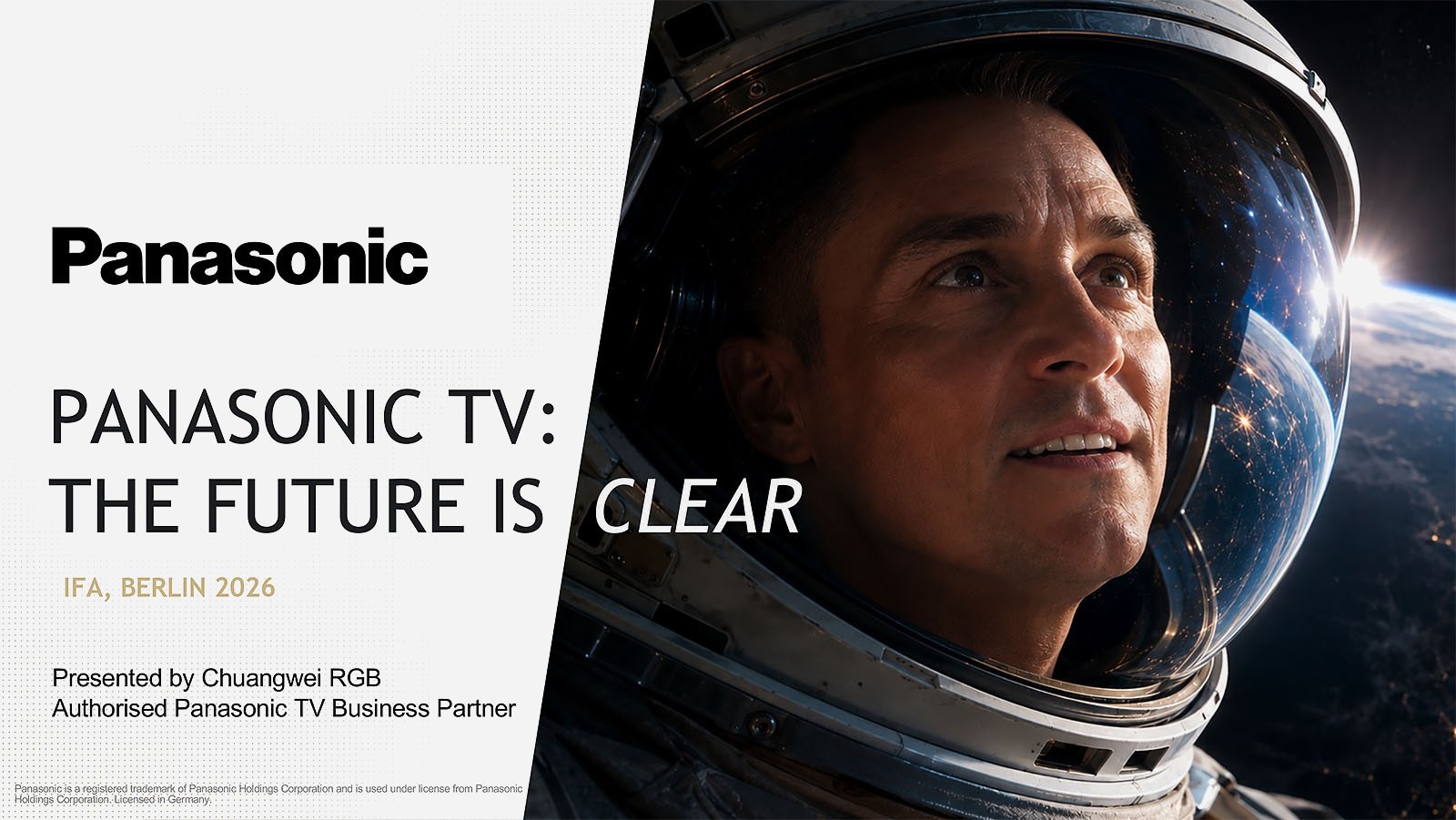
On the occasion of the IFA trade show in Berlin 2026, at the beginning of September, AVcesar was able to meet the new team in charge of marketing Panasonic TVs in Europe within the new company SWMEU GmbH, a subsidiary of the parent company Chuángwěi RGB (also known as Skyworth), namely Paul Darch (CEO & Managing Director) and Sebastian Wegielski (General Manager Europe & Managing Director), Olaf Borngräber-Huth (Head of Strategic Business Planning), Paul Williams (Press Relations). Also present at this meeting were Toshihiro Takagi (Product Planning, TV Business Division) and Haruka Kono (TV Business Division) from Panasonic, still in charge of developing Panasonic TVs, which the Japanese group still distributes and markets outside the United States and Europe.
Six months of absence explained at IFA in Berlin
If you have been following Panasonic TV news in recent months, you know that SWMEU GmbH was supposed to take effect on April 1. However, since that date passed, Panasonic had remained silent in a way that could have seemed worrying. Overall, the brand's TVs have been out of stock at most retailers, and the only announced Oled TV, the Z85C, has not made it to our shores. Fast-forward to the recent IFA trade show in Berlin, at the beginning of the month: a meeting at Panasonic's TV booth with the people mentioned above helped clarify the situation. The short answer to explain these six months? Panasonic has been incredibly active behind the scenes.
A delayed start for solid foundations
The company SWMEU GmbH, through its managers, readily acknowledges that the original April date has been greatly exceeded. Why? It was above all about doing things properly with this new partnership. That is why the company worked hard to lay solid industrial foundations and did not rush any new TV release onto the European market. The overall goal is clear: to restore the brand's position in Europe, with Panasonic aiming for fifth place in the pan-European market.
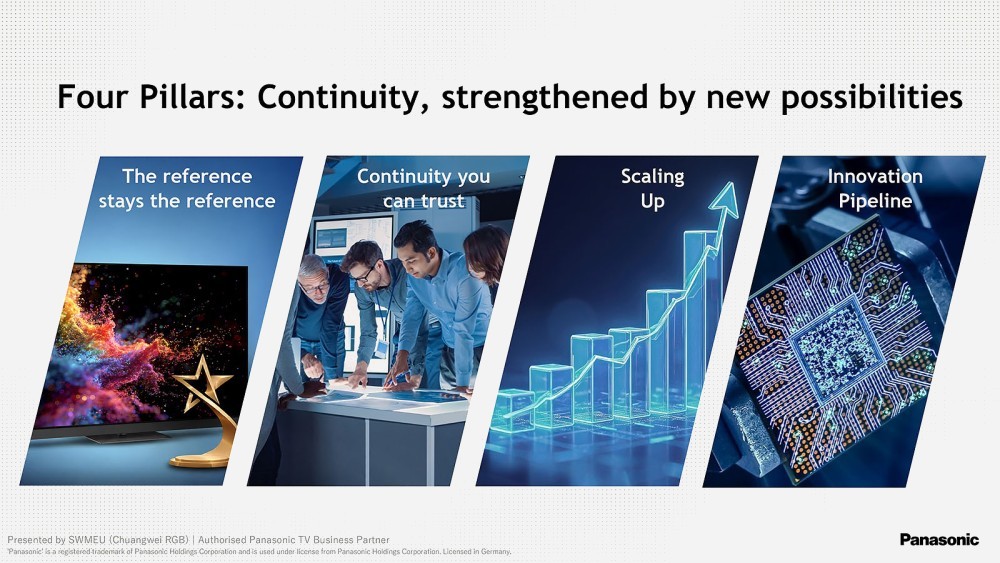
The development of the business is thus structured around four main pillars: "The benchmark remains the benchmark", "Continuity you can rely on", "Scaling up" and "Innovation pipeline". These are "the cornerstones of our strategy for moving forward," says CEO Paul Darch.
Oled as the ultimate flagbearer
The fact that Panasonic is keen to retain its position as a benchmark TV manufacturer is an extremely positive sign for movie lovers. The brand says that [abc]Oled[/abc] is the royal road to guaranteeing this legacy. It does not hesitate to point out that its high-end Oled models are favored by Hollywood editors and colorists, a prestigious status it intends to keep. "What we mean by that is that what was once a Panasonic TV remains a Panasonic TV. The same guiding principles governing picture, sound, design and the operating system continue," said Paul Darch. Enough to dispel the feared idea that future TVs would be nothing more than ordinary generic screens bearing the Panasonic logo.
Japanese engineering, Mini LED and continuity
While Oled remains the crown jewel, the company also recognizes the crucial importance of QD Mini LED in today's TV market. However, Paul Darch says that Panasonic will not "offer it just for the sake of offering it." The manufacturer will rely on its anti-reflective technology and formidable image processing to stand out from fierce competition from brands such as Hisense and TCL in this segment.
On the Japanese side, Toshihiro Takagi (product planning) specifies: "The goal is to ensure that the Japanese and international ranges reflect a coherent Panasonic TV identity." For premium models, Panasonic's legacy engineers will continue to be responsible for image calibration (the partnership with the calibration company Calman continues) and audio integration. A new [abc]DSP[/abc] algorithm is also being developed for the 2027 models, linked to a new speaker configuration. It remains to be seen whether Technics-calibrated audio systems will still be part of the picture, a question our interlocutors carefully sidestepped for now.
Draconian quality control
Behind the scenes, Panasonic Japan has rigorously audited manufacturing operations against the brand-approved criteria, ensuring that larger-scale production meets its own quality standards and historical expectations. This is not an acquisition, but a long-term collaboration. "Panasonic television is back," Paul Darch concluded emphatically. "That means a stronger product offering, a more robust sales and distribution strategy, a strengthened team backed by real resources for what truly lies ahead."
The end of our interview concluded with an appointment at the next CES in Las Vegas next January to discover the new 2027 TV lineup, the release dates and prices of these future televisions.
Oled as the ultimate flagbearer
The fact that Panasonic is keen to retain its position as a benchmark TV manufacturer is an extremely positive sign for movie lovers. The brand says that [abc]Oled[/abc] is the royal road to guaranteeing this legacy. It does not hesitate to point out that its high-end Oled models are favored by Hollywood editors and colorists, a prestigious status it intends to keep. "What we mean by that is that what was once a Panasonic TV remains a Panasonic TV. The same guiding principles governing picture, sound, design and the operating system continue," said Paul Darch. Enough to dispel the feared idea that future TVs would be nothing more than ordinary generic screens bearing the Panasonic logo.
Japanese engineering, Mini LED and continuity
While Oled remains the crown jewel, the company also recognizes the crucial importance of QD Mini LED in today's TV market. However, Paul Darch says that Panasonic will not "offer it just for the sake of offering it." The manufacturer will rely on its anti-reflective technology and formidable image processing to stand out from fierce competition from brands such as Hisense and TCL in this segment.
On the Japanese side, Toshihiro Takagi (product planning) specifies: "The goal is to ensure that the Japanese and international ranges reflect a coherent Panasonic TV identity." For premium models, Panasonic's legacy engineers will continue to be responsible for image calibration (the partnership with the calibration company Calman continues) and audio integration. A new [abc]DSP[/abc] algorithm is also being developed for the 2027 models, linked to a new speaker configuration. It remains to be seen whether Technics-calibrated audio systems will still be part of the picture, a question our interlocutors carefully sidestepped for now.
Draconian quality control
Behind the scenes, Panasonic Japan has rigorously audited manufacturing operations against the brand-approved criteria, ensuring that larger-scale production meets its own quality standards and historical expectations. This is not an acquisition, but a long-term collaboration. "Panasonic television is back," Paul Darch concluded emphatically. "That means a stronger product offering, a more robust sales and distribution strategy, a strengthened team backed by real resources for what truly lies ahead."
The end of our interview concluded with an appointment at the next CES in Las Vegas next January to discover the new 2027 TV lineup, the release dates and prices of these future televisions.